 South Korea · 경춘선
Gyeongchun Line
Yongsan Chuncheon
Filmed by KORAIL (코레일TV) · Yongsan → Chuncheon
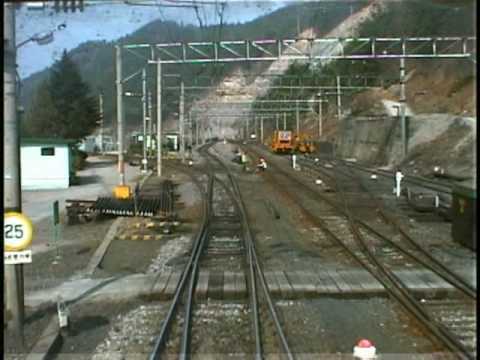
A cab ride on the ITX-Cheongchun from Yongsan to Chuncheon, out of Seoul on the Gyeongchun Line and up the valley of the Bukhangang to the lake city of Chuncheon.
The route
The Gyeongchun Line joins Seoul with Chuncheon, the capital of Gangwon Province; its name pairs the gyeong of the capital, then called Gyeongseong, with the chun of Chuncheon. It began as a private railway: after a local campaign, the Gyeongchun Railway company opened the line in July 1939, and it was nationalised after Korea's liberation. For generations the slow trains to Gangchon and Chuncheon were the classic weekend outing for students and young couples from Seoul, and the line holds a special place in Korean memory as a train of youth and romance.
The old single-track line wound along the river with many curves. A new double-track electrified alignment, begun in 1999, opened on 21 December 2010 and replaced most of the old route. It runs about 81 km from Sangbong in eastern Seoul to Chuncheon, with many bridges and tunnels totalling about 32 km, and the fastest sections allow 180 km/h. The trip from Sangbong to Chuncheon fell from two hours to under an hour and a half.
Since 2010 the line has been part of the Seoul Metropolitan Subway, and on 28 February 2012 Korail added the ITX-Cheongchun, a faster train with few stops running from Yongsan and Cheongnyangni. The abandoned riverside line has found new uses: the rail bike between Gimyujeong and Gangchon, opened in 2012, runs on the old track beside the Bukhangang, and in Seoul a disused stretch became the Gyeongchun Line Forest Park.
What you will see
This video was filmed from the driver's cab of an ITX-Cheongchun train. It begins at Yongsan in central Seoul and follows the north bank of the Han river east to Oksu, with the river and its bridges on the right. From Oksu the train turns north through the dense neighbourhoods of eastern Seoul to Cheongnyangni, one of the city's main railway hubs, and then heads out of the city towards the Gyeongchun Line.
After Cheongnyangni the line leaves Seoul and runs through the apartment towns of Namyangju to Pyeongnae-hopyeong. Beyond it the new alignment, straighter than the old one, crosses the wooded hills of eastern Gyeonggi Province, reaching the Bukhangang valley near Cheongpyeong and continuing to Gapyeong, the station for Nami Island and the riverside resorts. Only some ITX-Cheongchun trains stop at Cheongpyeong, and the train in this video runs straight through it.
Korail itself points to the stretch from Gapyeong to Namchuncheon, about 54:20–55:50 in the video, as the highlight, when the train runs beside the Bukhangang with the mountains rising on the far bank. The line then passes Gangchon and Gimyujeong, where the old track now carries rail bikes, and enters the basin of Chuncheon, a city ringed by lakes formed by dams on the river. The video ends at Chuncheon station, about 67 minutes after leaving Yongsan.
Riding it for real
Korail runs two kinds of service on the Gyeongchun Line. Seoul Metropolitan Subway trains, most of them from Sangbong and some from Cheongnyangni or Kwangwoon University, stop at every station and run every 15 to 30 minutes; they accept transit cards such as T-money. The ITX-Cheongchun, as filmed here, has reserved seats and stops only at the main stations such as Pyeongnae-hopyeong, Gapyeong and Namchuncheon; its fastest trains took 52 minutes from Cheongnyangni to Chuncheon.
For Nami Island get off at Gapyeong; for the rail bike, at Gimyujeong. Service patterns on this line have changed several times, so check Korail for current timetables and fares before you travel.
The video is embedded from YouTube and remains on its owner’s channel. Views count toward the original video.