How to watch a cab-ride video: signals, signs and what the driver sees
A viewer's guide to driver's-view train videos: signals, speed boards, gradient posts, passing loops, level crossings and tunnels, with what to look for on GONOM routes.
Cab or front window: where the camera sits
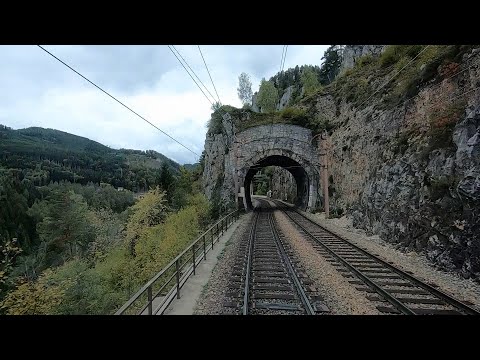
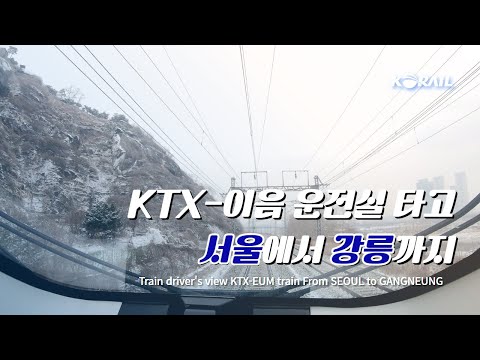
A cab-ride video is filmed from the driver's own position, usually with the operator's permission. On GONOM, the Semmering, Bohinj and Trutnov–Teplice films were shot from the cab, the last as part of Czech Railways' official front-view project, and the KTX Gangneung film from the cab of a KTX-Eum train. In two films a driver joins you: on the Zwolle–Amsterdam ride he talks through what he is doing, and a Deutsche Bahn long-distance driver presents the Rhine Gorge InterCity.
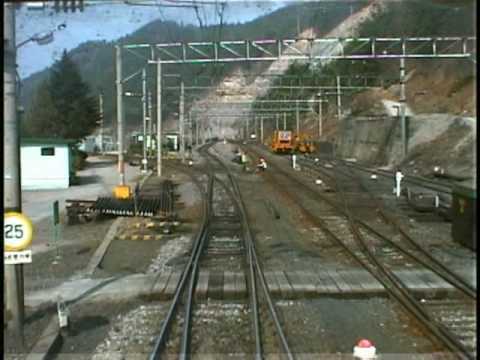
Other films are labelled front-window. They look forward from the front of the train, but not from the driver's seat. On the Nilgiri Mountain Railway the steam engine is coupled at the downhill end, so the uphill view comes from the leading coach; the Darjeeling and Yeongdong films are also front views. Expect a slightly different angle, the odd reflection and no view of the controls. Some official films are edited, too: the KTX video shows no speed or location data, and a few passages are blurred or muted.
Signals: arms and lights
Lineside signals tell the driver whether the line ahead is clear. There are two broad families. Semaphore signals use a pivoting arm: in British, German and North American practice a horizontal arm means stop, and an arm raised or lowered at an angle means proceed. Colour-light signals, which replaced semaphores across most of the world from the mid-twentieth century, use lamps instead. Semaphores still survive on some secondary routes, Britain among them. Because a train needs a long distance to stop, a stop signal often has a distant signal before it that warns the driver what to expect.
Resist reading the colours too literally. Red means stop almost everywhere, but yellow, flashing aspects, extra lamps and number displays mean different things from one country to the next, and even semaphores look different: British distant arms are yellow with a notched end, while German signals have quite different shapes. Some lines have hardly any lineside signals at all. On the Gotthard and Lötschberg base lines, the ETCS Level 2 system sends movement commands to the cab instead. The Gotthard film on GONOM follows the old line over the mountain, not the base tunnel.
Single track, passing loops and radio tokens
Many of the scenic lines on GONOM are single track, so trains travelling in opposite directions can pass only where the line divides into two for a short distance, at a loop or a station. Watch for the track splitting ahead, the points at each end and, sometimes, a train waiting on the other side. The Flåm Line has only one loop, at Berekvam, halfway down the valley. On the Highland Main Line and the Donghae Line, trains often pause at stations to let another one by.
The West Highland Line to Mallaig is a good place to see a different system. It is worked by Radio Electronic Token Block: the driver asks a signaller by radio for permission to enter the next section, and an electronic token is sent to a display in the cab. Instead of conventional signals at the ends of the loops, look for stop boards, simple fixed signs the driver may pass only once the token has been received and permission given.
Speed boards, gradient posts and distance markers
The small signs beside the track carry a lot of information. Speed boards show the limit for the stretch ahead, in kilometres per hour in most countries and in miles per hour in Britain and the United States. On Indian Railways, for example, a speed limit is a black number on a yellow triangular board, and a board with a 'T' marks where it ends. Distance markers count from a fixed starting point. British lines are still measured in miles, so there you will see mileposts; elsewhere kilometre posts are usual, often with smaller markers in between.
Gradient posts are worth learning. On British lines a typical post has two arms, one for each direction, angled up for a climb, down for a descent or level for flat track, with a figure such as 1 in 200: the track rises or falls one unit for every 200 travelled, so the smaller the second number, the steeper the slope. Indian Railways uses small slabs with a number and an arrow. On the Flåm Line, where the grade reaches 5.5 per cent, you can see what such figures mean in practice: the train creeps downhill, braking almost all the way.
Level crossings and trains in the street
Where road and railway meet on the level, watch for barriers, flashing lights and cars waiting. Many crossings have a board some way before them that tells the driver to sound the horn; on Indian Railways it is a yellow board marked 'W/L', set about 250 m before unmanned crossings. The Trutnov–Teplice nad Metují line is a good example of change: in 2015 and 2016 ten of its level crossings were rebuilt with light-signal protection, and the line speed was raised to 60 km/h.
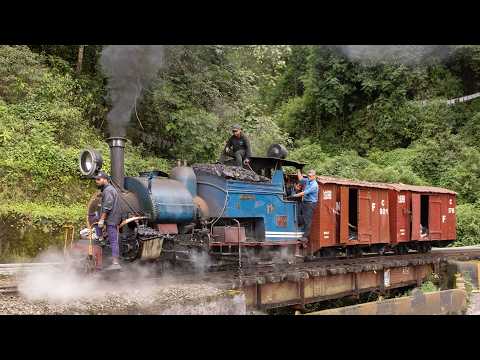
On some lines the railway and the road are the same place. On the Darjeeling Himalayan Railway the rails run along the Hill Cart Road for long stretches, so the train sounds its horn or whistle almost constantly and edges past walkers, lorries and road crews. The Bernina Line shares the village street at Le Prese and crosses the main square at Madonna di Tirano, where the train makes its way among people and cars.
Tunnels, portals and arrivals
Tunnels are where many viewers lose interest, but they tell a story. Some lines number their tunnels; the Nilgiri film begins at Tunnel No. 3 above Kallar. Long ones change the whole journey. The Bohinj tunnel, 6,327 m long, keeps the train under the mountain for several minutes and brings it out in a different valley. The Daegwallyeong Tunnel on the KTX Gangneung film runs for almost 22 km, and on the Gotthard line, after the 15 km summit tunnel, the station signs at Göschenen have changed from Italian to German.
Arrivals have their own rhythm. The train slows well before the platform, the track often fans out through a series of points at larger stations, as it does approaching Amersfoort, and the driver brings the train to a stand at a set place. In many countries, markers beside the track or on the platform show where trains of different lengths should stop. Once you know what to look for, a quiet stretch of a cab ride becomes a running account of how the railway is being worked.
Watch these journeys on GONOM
-
 Semmering Railway
Payerbach → Mürzzuschlag
Full journeyBoard
-
 Trutnov–Teplice nad Metují line
Trutnov → Teplice nad Metují
1h 8mBoard
-
 KTX Gangneung Line
Seoul → Gangneung
2h 0mBoard
-
 Zwolle–Amsterdam via Amersfoort
Zwolle → Amsterdam Centraal
1h 9mBoard
-
 Left Rhine Railway through the Rhine Gorge
Koblenz → Mainz
50mBoard
-
 Darjeeling Himalayan Railway
Kurseong → Darjeeling
Full journeyBoard
-
 Nilgiri Mountain Railway
Tunnel No. 3 (above Kallar) → Runneymede
48mBoard
-
 Yeongdong Line
Heungjeon → Dogye
10mBoard
-
 Gotthard mountain line
Bellinzona → Erstfeld
1h 28mBoard
-
 West Highland Line
Fort William → Mallaig
Full journeyBoard
-
 Flåm Line
Myrdal → Flåm
Full journeyBoard
-
 Highland Main Line
Inverness → Pitlochry
Full journeyBoard
-
 Donghae Line
Pohang → Gangneung
Full journeyBoard
-
 Bernina Line
St. Moritz → Tirano
1h 58mBoard
-
 Bohinj Railway
Jesenice → Nova Gorica
Full journeyBoard
Sources
More guides
- How mountain railways climb: loops, spirals, switchbacks and rack
- Korea's east coast by rail: Gangwon, the Donghae Line and Busan
- Japan beyond the Shinkansen: slow local lines worth watching
- Why subway maps look the way they do
- Rail journeys of Norway and Sweden
- Crossing the Alps by train: the Alpine cab rides on GONOM and how they connect
- Planning a rail trip from a cab-ride video: how to go from watching a line to riding it
- Railways on the UNESCO World Heritage List, and what earned them a place
- Hill railways of South Asia: Darjeeling, the Nilgiris and Sri Lanka's tea country
- Narrow gauge explained: standard, broad, metre and 2 ft track, and why the width matters
- Coastal railways: why lines by the sea are so hard to build and keep open
- Railways in winter: how trains keep running through snow, ice and avalanches
- Railway tunnels: summit tunnels, base tunnels and how they are dug
- Rail through the seasons: when to ride which kind of line
- British rail journeys: the West Highland, Highland Main, Dartmoor and East Coast lines
- Metro, commuter rail, light rail or tram: how to tell city trains apart
- Korean trains explained: KTX, KTX-Eum, ITX, Nuriro and Mugunghwa
- Everyday regional trains of Central Europe, and why they are worth watching
- Scenic railways of the Americas and New Zealand: built for gold, silver and ports