Crossing the Alps by train: the Alpine cab rides on GONOM and how they connect
A guide to GONOM's Alpine cab rides: the Albula and Bernina lines, the Gotthard, the Bernese Oberland, Semmering and Bohinj, with Munich, Vienna and Milan as bases.
Three ways through the mountains
The Alps were the hardest obstacle European railway builders faced, and the Alpine lines on GONOM show the different answers they found. Most of them climb by ordinary adhesion, keeping the gradient gentle enough for steel wheels on steel rails and gaining height with long loops, spiral tunnels and viaducts. Some use a rack, a toothed rail laid between the running rails, on slopes where adhesion alone is not enough. The newest answer is to go underneath: long base tunnels at low altitude now carry fast trains beneath passes that the original lines climbed over.
In a driver's-eye film these choices are easy to recognise once you know the signs. A spiral tunnel shows up as a long curve in the dark, followed by a view of the valley you have just passed, now seen from higher up. A rack section shows as a toothed rail in the middle of the track and a sudden, steady drop in speed. The six Alpine films on GONOM, from Switzerland, Austria and Slovenia, cover all of these.
Graubünden: the Albula and Bernina lines
The Glacier Express film covers only the eastern end of that famous journey: the run from St. Moritz down to Chur over the Albula line, which opened in 1903 and reached St. Moritz in 1904. Its engineers held the gradient to 3.5 per cent, so the drop from Preda to Bergün needed three spiral tunnels, two curved tunnels and four viaducts. Watch for track you have just used reappearing above or below you on the slope, then for the Landwasser Viaduct beyond Filisur, which curves out over the gorge and runs straight into a tunnel in the cliff.
The Bernina Line film starts from the same station and heads the other way, south over the Bernina Pass to Tirano in Italy. At Ospizio Bernina the line reaches 2,253 m, and on the descent it manages gradients of up to 7 per cent without a rack. The film was made in winter, so the bare country above the tree line is deep in snow and Lago Bianco, at the watershed between the Danube and the Po, lies frozen beside the track. Near the bottom, look for the Brusio spiral viaduct, where the track passes under its own arches.
In 2008 UNESCO inscribed the two lines together as the Rhaetian Railway in the Albula / Bernina Landscapes. They were listed as working railways rather than museum pieces, and regional trains still share the largely single track with the panoramic services. Watched back to back, the two films join into one crossing between Chur and Tirano by way of St. Moritz, which is the route of the Bernina Express panoramic train today. Together they take you from the Rhine valley over two passes and down into Italy.
The Gotthard: over the top or under it
The Gotthard railway opened in 1882 as the first rail route straight through the central Alps. Its summit tunnel between Airolo and Göschenen is about 15 km long and reaches 1,151 m inside the mountain. GONOM's film runs northbound from Bellinzona to Erstfeld and shows how the line climbs to the tunnel: through the spiral tunnels at the Biaschina and Piottino gorges in the Leventina, and on the north side around Wassen, where the village church appears three times, each time at a different level.
Since 2016 most through trains no longer use this route. The Gotthard Base Tunnel, 57 km long and the longest railway tunnel in the world, opened in June 2016 and joined the regular timetable that December, so trains between Zurich and Milan now pass about 500 m lower. If you take one of them, you will see very little of what the film shows. The mountain line is still served by regional trains, the Treno Gottardo and, in the warmer months, the Gotthard Panorama Express. Near the end of the film, at Erstfeld, the base tunnel line rejoins the old route.
The Bernese Oberland: where the rack begins
The shortest of the Swiss films, about half an hour, follows the Bernese Oberland Railway from Interlaken Ost to Grindelwald. The line opened in 1890 and climbs from 567 m to 1,034 m in about 19 km. Most of it works by adhesion, but two Riggenbach rack sections handle gradients of up to 12 per cent, and in the film you can see the toothed rail appear in the centre of the track as the train slows. At Zweilütschinen, trains usually divide, with one half going to Lauterbrunnen and the other to Grindelwald, and the Eiger fills the view on the final approach.
This line is the first step into the Jungfrau region rather than a crossing of the Alps. At Grindelwald it meets the Wengernalpbahn towards Kleine Scheidegg, and a stop just below the village, Grindelwald Terminal, connects with the cableway to Männlichen. The film is a good companion to the Gotthard and Albula rides: it shows the alternative that engineers chose when a valley was simply too steep for adhesion, and it is also an everyday railway for the people who live along the valley.
East of Switzerland: Semmering and Bohinj
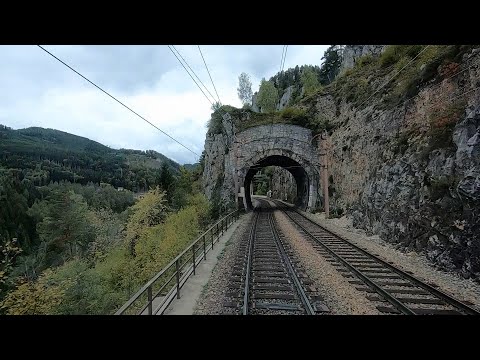
The Semmering Railway in Austria is the oldest line in this group. Carl von Ghega planned and directed its construction between 1848 and 1854, and it is described as the first standard-gauge mountain line in Europe. Rather than ropes or a rack, Ghega used tight curves along the valley sides, 14 tunnels and 16 viaducts. UNESCO inscribed it in 1998, and it remains a working main line. In the film, look for the ruins of Klamm castle above the tunnel near Schottwien and for the two-storey Kalte Rinne viaduct, once shown on the Austrian 20 schilling note. A base tunnel is under construction and is expected to open around 2030.
The Bohinj Railway in Slovenia crosses the Julian Alps, at the south-eastern edge of the Alpine chain. Austria-Hungary opened it in 1906 as part of a new route to Trieste. The film passes Lake Bled, runs through the 6,327 m Bohinj tunnel and follows the Soča valley down to the Solkan bridge, whose 85 m span is the largest stone arch on any railway bridge.
Munich, Vienna and Milan as bases
Three of GONOM's subway maps cover cities on the edges of the Alps, and each makes a sensible base. Vienna is the natural starting point for the Semmering: regional trains run from the city towards Mürzzuschlag, and long-distance Railjets towards Graz cross the pass. On GONOM's Vienna U-Bahn map, Hauptbahnhof, the main railway station, is on line U1, which also reaches Karlsplatz and Stephansplatz in the old town.
Milan works the same way for the southern side. Trenord regional trains link Milano Centrale with Tirano, where the Bernina Line ends, and trains north from Milan into Ticino approach the Gotthard from the Bellinzona side. On the Milan map, Centrale is served by lines M2 and M3. Munich's Hauptbahnhof, where six U-Bahn lines meet main-line trains on two levels, has long-distance services towards Switzerland and Austria. Before you plan around any of these connections, check the operators' journey planners, because services and seasonal dates change.
Watch these journeys on GONOM
-
 Glacier Express route
St. Moritz → Chur
1h 54mBoard
-
 Bernina Line
St. Moritz → Tirano
1h 58mBoard
-
 Gotthard mountain line
Bellinzona → Erstfeld
1h 28mBoard
-
 Bernese Oberland Railway
Interlaken Ost → Grindelwald
31mBoard
-
 Semmering Railway
Payerbach → Mürzzuschlag
Full journeyBoard
-
 Bohinj Railway
Jesenice → Nova Gorica
Full journeyBoard
Subway maps mentioned
Sources
More guides
- How mountain railways climb: loops, spirals, switchbacks and rack
- How to watch a cab-ride video: signals, signs and what the driver sees
- Korea's east coast by rail: Gangwon, the Donghae Line and Busan
- Japan beyond the Shinkansen: slow local lines worth watching
- Why subway maps look the way they do
- Rail journeys of Norway and Sweden
- Planning a rail trip from a cab-ride video: how to go from watching a line to riding it
- Railways on the UNESCO World Heritage List, and what earned them a place
- Hill railways of South Asia: Darjeeling, the Nilgiris and Sri Lanka's tea country
- Narrow gauge explained: standard, broad, metre and 2 ft track, and why the width matters
- Coastal railways: why lines by the sea are so hard to build and keep open
- Railways in winter: how trains keep running through snow, ice and avalanches
- Railway tunnels: summit tunnels, base tunnels and how they are dug
- Rail through the seasons: when to ride which kind of line
- British rail journeys: the West Highland, Highland Main, Dartmoor and East Coast lines
- Metro, commuter rail, light rail or tram: how to tell city trains apart
- Korean trains explained: KTX, KTX-Eum, ITX, Nuriro and Mugunghwa
- Everyday regional trains of Central Europe, and why they are worth watching
- Scenic railways of the Americas and New Zealand: built for gold, silver and ports