Hill railways of South Asia: Darjeeling, the Nilgiris and Sri Lanka's tea country
How three colonial railways reached the hills of India and Sri Lanka, what tea had to do with them, why their gauges differ, and what life along them looks like today.
Railways built to reach the hills
In the nineteenth century the British in South Asia looked to the hills for two things. One was relief from the heat of the plains, which turned places such as Darjeeling, Ooty and Shimla into hill stations where officials and their families spent the hot months; Shimla even became the summer capital of British India. The other was land for plantation crops, coffee at first and then tea. Both needed transport. Carts on mountain roads were slow and costly, and from the 1860s railways began to climb from the plains towards the ridges.
GONOM has three of these lines in cab-ride films. The Darjeeling Himalayan Railway climbs into the eastern Himalaya in West Bengal, the Nilgiri Mountain Railway climbs into the Nilgiri hills of Tamil Nadu, and Sri Lanka's Main Line runs down from Nanu Oya to Kandy through the island's hill country. They were built for similar reasons within a few decades of each other, yet they look and work very differently, starting with the width of the track.
Darjeeling: tea, timber and the Hill Cart Road
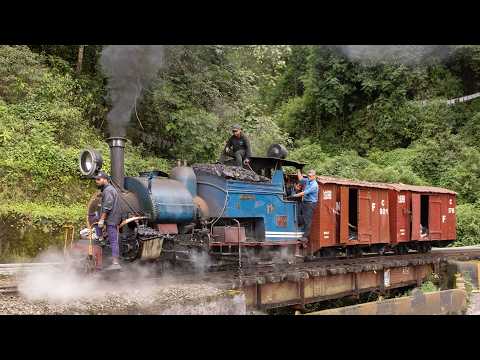
Franklin Prestage, an agent of the Eastern Bengal Railway, proposed a line up to Darjeeling, and Gillanders, Arbuthnot and Company built it on 2 ft gauge, reaching Kurseong in 1880 and Darjeeling in July 1881. It was laid along the Hill Cart Road, the existing road into the hills, and for decades it carried tea, timber and people. In 1910 it moved 174,000 passengers and 47,000 tons of goods. Jorebungalow, near the top of the line, was once the store point for tea from nearby estates on its way down to Calcutta.
The road is still the setting. For long stretches the rails run in the carriageway, so trains share space with cars, trucks and people on foot, and the horn and whistle sound almost constantly. In the GONOM film, B class steam engine No. 802 edges past a road repair crew near Sonada, works through a traffic jam towards Jorebungalow and squeezes through the streets of Ghum, at 2,258 m the highest station in India, before running down round the Batasia Loop to Darjeeling. Watch how close the houses and shopfronts stand to the rails.
The Nilgiris: a long wait, then a rack
A railway to Ooty was planned as early as 1854, but money and terrain held it back for decades. The metre gauge line opened from Mettupalayam to Coonoor in 1899 and reached Ooty in 1908. Between Kallar and Coonoor the gradient reaches 1 in 12, and the line uses an Abt rack, the only rack railway still working in India. Most of its X class steam engines were built in Winterthur in Switzerland; the newest was completed at the Golden Rock workshops in 2021, and many now burn oil instead of coal to lower the risk of forest fires.
The GONOM film climbs the rack from a tunnel above Kallar to Runneymede. It passes Adderly, a water stop that no longer takes passengers, and Hillgrove, a block post where the engine takes water and passengers often step out to the kiosk until a long whistle calls them back. Above Hillgrove the first tea plantations appear on the slopes. Southern Railway still runs a scheduled train each way, timed to connect with the overnight Nilagiri Express from Chennai, so the line remains part of an ordinary journey and not only an excursion.
Sri Lanka: coffee first, then tea
In Ceylon the push for a railway came from European coffee planters, who from 1842 pressed for a line between Kandy and the port of Colombo. The first train ran from Colombo towards Ambepussa in December 1864, and the rails reached Kandy in 1867. Shortly after 1869 a fungal disease, coffee leaf rust, began to destroy the plantations, and tea replaced coffee as the main estate crop. The railway kept climbing into what became tea country: Nawalapitiya in 1874, Nanu Oya in 1885 and finally Badulla in 1924.
That is the landscape in the GONOM film, which runs downhill from Nanu Oya, at about 1,613 m, to Kandy in about three and a half hours behind a Class M5B diesel. Below Nanu Oya the line winds past Radella, Great Western and Talawakele through hillsides planted with tea. Hatton, a little over an hour in, is the railhead for Adam's Peak. The line then drops through forest and estates to Nawalapitiya on the Mahaweli river and follows the valley past Gampola, a fourteenth-century capital, to Peradeniya Junction and Kandy.
Three gauges for three hill lines
The three lines run on three different track widths. Darjeeling is 2 ft, or 610 mm; the Nilgiri line is metre gauge; and Sri Lanka's Main Line uses 1,676 mm broad gauge, the same as India's main lines. The choice reflected cost and terrain. Histories of the Indian network note that broad gauge was chosen for main lines with freight and stability in mind, while 2 ft and 2 ft 6 in lines were cheaper and quicker to lay in difficult country. The Nilgiri line sits between the two.
Sri Lanka took a different path, carrying broad gauge into the hills and climbing steadily along valley sides and spurs, so trains run from Colombo to Badulla without a change of gauge. Narrow gauge did reach the hill country as branches: one ran from Nanu Oya to Nuwara Eliya and Ragala from 1903 to 1948. In India, Project Unigauge has converted many metre and narrow gauge lines to broad gauge since 1990, but the Nilgiri line is expected to stay as it is. Our guide to narrow gauge explains the trade-offs in more detail.
Life along the line today
None of these railways is only a tourist ride. Hatton handles around a million passengers during the Adam's Peak pilgrimage season from December to May, and named trains such as the Udarata Menike and Podi Menike carry residents between Colombo, Kandy and Badulla as well as visitors. In Darjeeling, scheduled diesel trains link New Jalpaiguri on the plains with the hills, while short joy rides from Darjeeling to Ghum and back by the Batasia Loop serve visitors, some of them behind steam.
The monsoon shapes all three lines. Heavy rain brings landslides and rockslides that can close the Darjeeling and Nilgiri lines, sometimes for long periods, and cloud and mist often sit on the higher ridges in Sri Lanka. If a film makes you want to ride, plan for the months outside the heaviest rain and check the operator before you go. In the films themselves, notice the small things that keep these lines running: water stops, staffed stations, level crossings and the people waiting at every halt.
Watch these journeys on GONOM
-
 Darjeeling Himalayan Railway
Kurseong → Darjeeling
Full journeyBoard
-
 Nilgiri Mountain Railway
Tunnel No. 3 (above Kallar) → Runneymede
48mBoard
-
 Main Line through the Hill Country
Nanu Oya → Kandy
Full journeyBoard
Sources
More guides
- How mountain railways climb: loops, spirals, switchbacks and rack
- How to watch a cab-ride video: signals, signs and what the driver sees
- Korea's east coast by rail: Gangwon, the Donghae Line and Busan
- Japan beyond the Shinkansen: slow local lines worth watching
- Why subway maps look the way they do
- Rail journeys of Norway and Sweden
- Crossing the Alps by train: the Alpine cab rides on GONOM and how they connect
- Planning a rail trip from a cab-ride video: how to go from watching a line to riding it
- Railways on the UNESCO World Heritage List, and what earned them a place
- Narrow gauge explained: standard, broad, metre and 2 ft track, and why the width matters
- Coastal railways: why lines by the sea are so hard to build and keep open
- Railways in winter: how trains keep running through snow, ice and avalanches
- Railway tunnels: summit tunnels, base tunnels and how they are dug
- Rail through the seasons: when to ride which kind of line
- British rail journeys: the West Highland, Highland Main, Dartmoor and East Coast lines
- Metro, commuter rail, light rail or tram: how to tell city trains apart
- Korean trains explained: KTX, KTX-Eum, ITX, Nuriro and Mugunghwa
- Everyday regional trains of Central Europe, and why they are worth watching
- Scenic railways of the Americas and New Zealand: built for gold, silver and ports