Everyday regional trains of Central Europe, and why they are worth watching
How regional rail works in the Netherlands, Czechia, Germany, Austria and Slovenia, and what ordinary lines like Zwolle–Amersfoort and Trutnov show from the cab.
The trains most people actually ride
Famous railway journeys get the attention, but the trains most Europeans ride are regional ones: stopping services that link small towns with the nearest city, carry school pupils and commuters, and run all day in a regular pattern. They are rarely fast and seldom marketed to visitors. From the driver's cab, though, they show a working railway more honestly than any panoramic train, with its level crossings, small stations, junctions and the steady routine of stopping and starting.
Five GONOM videos from the Netherlands, the Czech Republic, Germany, Austria and Slovenia cover this kind of railway. Each country organises its regional trains differently, and knowing a little about who runs them, and why, makes the films easier to read. This guide looks at each in turn, from the flat Dutch polders to the Julian Alps, and ends with what these ordinary lines have in common.
The Netherlands: Intercity and Sprinter on one network
Dutch rail is organised in layers. The national ministry grants the concessions; ProRail, wholly owned by the state, builds and maintains the track and stations and runs traffic control; NS holds the sole right to carry passengers on the main network until 2029; and provinces grant concessions for some regional lines. NS runs two main kinds of train. A Sprinter stops at all stations. An Intercity stops only at larger ones, except on lines without a Sprinter, where it calls everywhere. The timetable is built on regular, clock-face patterns, so trains repeat at the same minutes each hour, and connections at junctions are planned around them.
The Zwolle–Amersfoort video follows the old Utrecht–Kampen railway, opened in 1863 and 1864, on an ICM Intercity, a class built with a door at the front so coupled trains can be walked through. Watch for the Hanzelijn to Lelystad branching off at Hattemerbroek, the woods and heath on the Veluwe edge around Nunspeet, and the fan of tracks at Amersfoort, one of the main junctions of the network. The driver talks through the whole ride, explaining what he is doing.
Czechia: branch lines and railcars
The Czech rail network is one of the densest in the world, with more than 9,600 km of line, and much of it is single-track branch line, built after the first main lines to reach the smaller towns. Trains are classed as Os, the stopping train; Sp, a faster regional train that skips small places; and R, the longer-distance express. Regional services are contracted by the country's regions. Czech Railways (ČD) is the traditional operator, but private companies have won some of these contracts in competitive awards.
Line 047 from Trutnov to Teplice nad Metují is a classic example: about 35 km of single track near the Polish border, worked by a class 814 diesel railcar. In 2015 and 2016 the infrastructure manager Správa železnic rebuilt the track and gave ten level crossings light signals, raising the line speed to 60 km/h. The video comes from Pohled z vlaku, ČD's own cab-view channel, which has more than 105,000 subscribers and is partly meant to attract new staff. Watch for the simple village halts and, near the end, the first sandstone towers of the Adršpach rocks beside the track.
Germany: regional trains ordered by the states
Since 1996 Germany's federal states, rather than the national government, have been responsible for regional rail. Deutsche Bahn's own account of the reform puts it plainly: the duties and spending for local rail passed from the federal government to the states, which now decide how much to spend and from which provider to order which service. That is why many regional trains in Germany are run by companies other than DB, under contracts with the states' transport authorities.
The Rhine Valley video is filmed on a long-distance InterCity, but it shows how a busy main line carries everything at once. On the west bank between Koblenz and Bingen, long-distance, regional and freight trains share two tracks squeezed between the river and the rock. Watch the small stations along the shore, such as Rhens and Oberwesel, which are served by the stopping trains, and look across the water for trains on the second line along the east bank. At Boppard, the Hunsrück Railway climbs away as Germany's steepest adhesion line.
Austria and Slovenia: local trains on historic lines
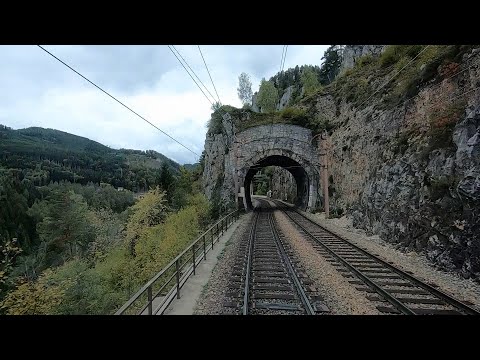
In Austria and Slovenia, two of GONOM's best-known mountain lines are also everyday regional railways. The Semmering Railway, inscribed by UNESCO in 1998, is still a working ÖBB main line. Talent and Desiro ML units run its local services, stopping at mountain stations such as Breitenstein, while heavier trains are hauled by Taurus locomotives. When the Semmering Base Tunnel opens, expected around 2030, long-distance and freight trains will go under the mountain, and the old line will be left mainly to regional trains and visitors.
Slovenia's Bohinj Railway lost its through traffic to the coast in the early 1990s and has carried mainly local trains since, together with a car train through the Bohinj tunnel. GONOM's film was made from the cab of an ordinary regional train in March 2022. Watch for how often it stops, at Bled Jezero above the lake, at small stations down the narrow Bača valley past Hudajužna and Grahovo, and at Solkan just after the long stone arch over the Soča. Each stop is short, and few passengers get on or off.
What these ordinary lines have in common
Watched side by side, the five films show what regional rail is for. Stations are close together and simple, often a platform and a shelter. Single track is common away from the cities, so trains wait for each other at passing places. Level crossings over country roads come up again and again on the Czech line, where the recent rebuild gave ten of them light signals. And the people waiting on the platforms are going to school, to work or to the shops, not on holiday.
That is what makes these rides worth watching. They show how a country uses its railways day to day, and the routine gives you time to notice signals, junctions and the way the line follows the land. GONOM's guide to watching a cab ride explains the signs and signals in more detail; the regional lines are the best place to practise, because there is time between stops to look.
Watch these journeys on GONOM
-
 Zwolle–Amsterdam via Amersfoort
Zwolle → Amsterdam Centraal
1h 9mBoard
-
 Trutnov–Teplice nad Metují line
Trutnov → Teplice nad Metují
1h 8mBoard
-
 Left Rhine Railway through the Rhine Gorge
Koblenz → Mainz
50mBoard
-
 Semmering Railway
Payerbach → Mürzzuschlag
Full journeyBoard
-
 Bohinj Railway
Jesenice → Nova Gorica
Full journeyBoard
Subway maps mentioned
Sources
More guides
- How mountain railways climb: loops, spirals, switchbacks and rack
- How to watch a cab-ride video: signals, signs and what the driver sees
- Korea's east coast by rail: Gangwon, the Donghae Line and Busan
- Japan beyond the Shinkansen: slow local lines worth watching
- Why subway maps look the way they do
- Rail journeys of Norway and Sweden
- Crossing the Alps by train: the Alpine cab rides on GONOM and how they connect
- Planning a rail trip from a cab-ride video: how to go from watching a line to riding it
- Railways on the UNESCO World Heritage List, and what earned them a place
- Hill railways of South Asia: Darjeeling, the Nilgiris and Sri Lanka's tea country
- Narrow gauge explained: standard, broad, metre and 2 ft track, and why the width matters
- Coastal railways: why lines by the sea are so hard to build and keep open
- Railways in winter: how trains keep running through snow, ice and avalanches
- Railway tunnels: summit tunnels, base tunnels and how they are dug
- Rail through the seasons: when to ride which kind of line
- British rail journeys: the West Highland, Highland Main, Dartmoor and East Coast lines
- Metro, commuter rail, light rail or tram: how to tell city trains apart
- Korean trains explained: KTX, KTX-Eum, ITX, Nuriro and Mugunghwa
- Scenic railways of the Americas and New Zealand: built for gold, silver and ports