Railways on the UNESCO World Heritage List, and what earned them a place
Why UNESCO inscribed the Semmering Railway, the Albula and Bernina lines and India's mountain railways, what outstanding universal value means, and how to see it on film.
A working railway as a monument
Most places on UNESCO's World Heritage List are buildings, old towns, ruins or wild landscapes. Railways arrived late. The Semmering Railway in Austria, inscribed in 1998, was the first railway listed in its own right. India's Darjeeling Himalayan Railway followed in 1999, and the listing was later extended to the Nilgiri Mountain Railway in 2005 and the Kalka–Shimla Railway in 2008, forming the Mountain Railways of India. In 2008 the Albula and Bernina lines in Switzerland and Italy were also inscribed, as the Rhaetian Railway in the Albula/Bernina Landscapes, and in 2021 the Trans-Iranian Railway joined them.
Other railway sites on the list are single structures, such as the Forth Bridge in Scotland or the Chhatrapati Shivaji Terminus station in Mumbai. What sets these lines apart is that the whole route is the monument: track, tunnels, bridges, stations and the trains that still run over them every day. GONOM has cab-ride films from five of these lines, and each shows a different side of what UNESCO decided was worth protecting.
What outstanding universal value means
To be inscribed, a place must have what the World Heritage Convention calls outstanding universal value: an importance so exceptional that it reaches beyond the country where it stands and matters to people now and in the future. In practice that value has to be shown against at least one of ten criteria. The site must also pass two further tests: integrity, meaning it is complete enough to carry its story, and, for cultural sites, authenticity, meaning that what you see is genuinely what it claims to be.
All three railway sites discussed here were listed under the same two criteria. Criterion (ii) asks for an important interchange of human values, for example in technology or landscape design, over time or within a region. Criterion (iv) asks for an outstanding example of a type of building or technological ensemble that illustrates a significant stage in human history. For a railway, that comes down to two questions: did it change how others built, and does it show, better than almost anything else, a particular moment in the history of railways?
Semmering: the line that made a landscape
UNESCO describes the Semmering Railway, built between 1848 and 1854 over 41 km of high ground, as an outstanding technological solution to a major physical problem in the pioneering years of railway building. That is the engineering half of its value. The other half is less obvious. Once the line made the mountains easy to reach from Vienna, villas and hotels for summer visitors went up along it, and UNESCO counts this new landscape of leisure as part of the site under criterion (iv).
The Semmering statement is also frank about change. The line was electrified in the 1950s, worn parts have been replaced and working methods have moved on, yet UNESCO judges the route and its engineering works fully authentic, and stresses that the line has run without a break since 1854. That is why a modern electric locomotive in the GONOM film spoils nothing. Watch instead for the stone: the two-storey viaducts, the Kalte Rinne viaduct above Breitenstein and the masonry tunnel portals, all still carrying a main line.
The Rhaetian Railway: a line and its landscape
The Albula line, 67 km long with 42 tunnels and galleries and 144 bridges and viaducts, opened in 1903 and 1904. The Bernina line, 61 km with 13 tunnels and galleries and 52 bridges, was finished in 1910. UNESCO says the two were built to end the isolation of settlements in the Central Alps and changed mountain life for good. Under criterion (ii) it points to a comprehensive and diversified set of innovative solutions and to the harmony between the lines and the land they cross. Under criterion (iv) it calls them a very significant illustration of mountain railways at high altitude.
The word landscapes in the name matters. The listed property covers only about 152 hectares, essentially the railway corridor, but its buffer zone takes in more than 109,000 hectares of valleys, villages and peaks. On GONOM, the Glacier Express film covers the Albula line from St. Moritz to Chur, and the Bernina Line film crosses the pass to Tirano. Rather than counting spirals, which our guide to how mountain railways climb covers, notice how most bridges are stone arches rather than steel, how small the stations are, and how the line serves villages as well as visitors.
Mountain Railways of India: three lines, one site
The Indian site groups three lines built under British rule to reach the hills. The Darjeeling Himalayan Railway, opened in 1881 on 2 ft gauge track, was listed first. The Nilgiri Mountain Railway, metre gauge and completed to Ooty in 1908, was added in 2005. The Kalka–Shimla Railway, a 96 km line of 2 ft 6 in gauge opened in 1903 to serve Shimla, the summer capital of British India, followed in 2008. UNESCO calls them outstanding examples of bold, ingenious engineering for linking rugged mountain country by rail, and all three are still fully working railways.
Here the trains themselves carry much of the value. In the Darjeeling film the engine is a B class 0-4-0 saddle tank, a type built between 1889 and 1925, running along the Hill Cart Road through Sonada and Ghum as the railway has done since the 1880s. In the Nilgiri film an X class steam engine, of a class mostly built in Winterthur in Switzerland, works up the rack from Kallar past the old water stops at Adderly and Hillgrove. Kalka–Shimla, with 102 tunnels still in use, is not yet on GONOM.
How to watch a listed railway
A World Heritage railway is not a museum line kept for show. Semmering is still part of Austria's Southern Railway, the Rhaetian lines carry local trains as well as panoramic services, and the Indian lines carry residents as well as visitors. That everyday use is part of the case UNESCO accepted, and it explains why change is allowed: new locomotives, electrification and modern safety equipment. What has to survive is the route, its structures and the relationship between the line and the places it serves.
So when you watch these films, look past the train. Look for original station buildings, retaining walls and drainage channels beside the track, villages that grew up along the line, and the way the railway threads between them. On Semmering there is a change coming: the base tunnel due around 2030 will take fast long-distance and freight trains under the mountain, leaving the listed route to regional trains and visitors, much as the Rhaetian lines already work today.
Watch these journeys on GONOM
-
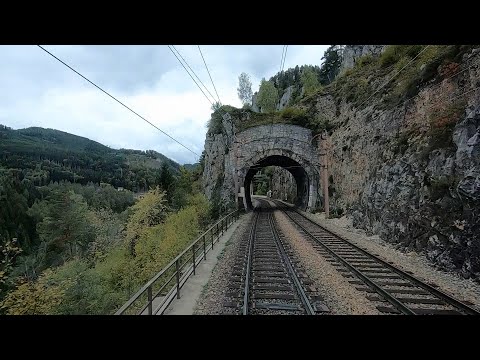 Semmering Railway
Payerbach → Mürzzuschlag
Full journeyBoard
-
 Glacier Express route
St. Moritz → Chur
1h 54mBoard
-
 Bernina Line
St. Moritz → Tirano
1h 58mBoard
-
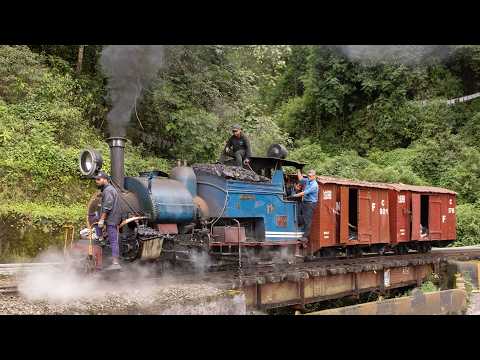 Darjeeling Himalayan Railway
Kurseong → Darjeeling
Full journeyBoard
-
 Nilgiri Mountain Railway
Tunnel No. 3 (above Kallar) → Runneymede
48mBoard
Sources
More guides
- How mountain railways climb: loops, spirals, switchbacks and rack
- How to watch a cab-ride video: signals, signs and what the driver sees
- Korea's east coast by rail: Gangwon, the Donghae Line and Busan
- Japan beyond the Shinkansen: slow local lines worth watching
- Why subway maps look the way they do
- Rail journeys of Norway and Sweden
- Crossing the Alps by train: the Alpine cab rides on GONOM and how they connect
- Planning a rail trip from a cab-ride video: how to go from watching a line to riding it
- Hill railways of South Asia: Darjeeling, the Nilgiris and Sri Lanka's tea country
- Narrow gauge explained: standard, broad, metre and 2 ft track, and why the width matters
- Coastal railways: why lines by the sea are so hard to build and keep open
- Railways in winter: how trains keep running through snow, ice and avalanches
- Railway tunnels: summit tunnels, base tunnels and how they are dug
- Rail through the seasons: when to ride which kind of line
- British rail journeys: the West Highland, Highland Main, Dartmoor and East Coast lines
- Metro, commuter rail, light rail or tram: how to tell city trains apart
- Korean trains explained: KTX, KTX-Eum, ITX, Nuriro and Mugunghwa
- Everyday regional trains of Central Europe, and why they are worth watching
- Scenic railways of the Americas and New Zealand: built for gold, silver and ports