Railways in winter: how trains keep running through snow, ice and avalanches
How railways in Norway, the Alps, Japan and Alaska keep trains moving in winter, from snow fences and sheds to wedge and rotary ploughs and heated points.
Why snow is harder for a railway than for a road
A road can be cleared by any truck and driven slowly with chains. A railway has much less room for error. Its wheels ride on two narrow rails, its points must move a few centimetres to set a route, and electric trains draw their power from a wire that has to stay free of ice. The depth of snow is rarely the worst problem. Drifting is. Wind lifts loose snow off open ground and drops it wherever the air slows down, which on a railway means cuttings, station areas and the sheltered side of embankments. A cutting can fill to the brim overnight while the open fell beside it stays almost bare.
The Bergen Line learned this before it had even opened. In December 1907 a train sent over the high plateau got stuck in heavy snow and had to turn back, and clearing the line took about a month and a half. Almost everything that keeps Norway's mountain railways open today, from fences and sheds to ploughs and tunnels, grew out of winters like that one, and the same set of tools, adapted to local snow, is used from the Alps to Japan.
Fences and sheds: stopping snow before it reaches the track
The cheapest defence is a snow fence: a row of slatted boards or panels set some way upwind of the line. It works by slowing the wind rather than blocking it. As the air loses speed it drops the snow it is carrying, so the drift builds up behind the fence instead of on the rails. On the Bergen Line, snow fences and snow tunnels were added around Hallingskeid from the autumn of 1909, the year the line opened, to cover the track, the passing loop and the station itself.
Where fences are not enough, the railway is roofed over. A snow shed is a long timber or concrete gallery built over the track, and the Bergen Line has tens of kilometres of them on its most exposed stretches. Some also guard against avalanches, though each is built for a certain load. In 2025 an avalanche struck a Bergen Line snow shed built in 2019, and Bane NOR explained that it had been designed for smaller slides only, until snow built up on its back later in the winter. In Scotland, Network Rail has built avalanche shelters on its most vulnerable stretches.
Ploughs: wedge and rotary
Snow that does reach the line is cleared by ploughs. The simplest is the wedge plough, a steel blade shaped like a ship's bow, fixed to the front of a locomotive or mounted on a vehicle of its own. It shoulders the snow aside as it moves and needs speed to do so. In deep, packed drifts a wedge simply stalls, because there is too much snow and nowhere for it to go.
The answer was the rotary plough, developed in Canada in the 1880s. Orange Jull improved an earlier idea, and a full-size machine built with the Leslie brothers of Toronto worked in the winter of 1883 to 1884. A large wheel of blades at the front cuts into the snow and throws it out through a chute to one side, so the plough can advance slowly through cuttings a wedge could never open. Early rotaries were steam-powered, and the White Pass & Yukon Route still keeps one in working order. Japan uses rotary ploughs widely in its mountain passes, and on the Bergen Line large diesel-electric ploughs were stationed at Finse until the Finse Tunnel opened.
In the cab films the result is easy to spot. On the Tadami Line, in the deep snow country around Tadami, the winter track runs between high white banks of snow that the ploughs have thrown aside. GONOM's White Pass film was made in summer, but the railway's season runs only from late May to September, and snow can linger at the summit into June.
Going underneath when a stretch costs too much to keep open
Sometimes the best protection is to abandon the most exposed ground. The 22 km between Finse and Hallingskeid, above 1,200 m on Hardangervidda, were the hardest part of the Bergen Line to keep clear, and heavy snow and drifts often closed the whole line. A tunnel was proposed in 1984, Parliament approved it in 1989, and the 10.5 km Finse Tunnel opened in 1992. The line's highest point, 1,237 m, now lies inside the mountain, and the snow-clearing base at Finse closed.
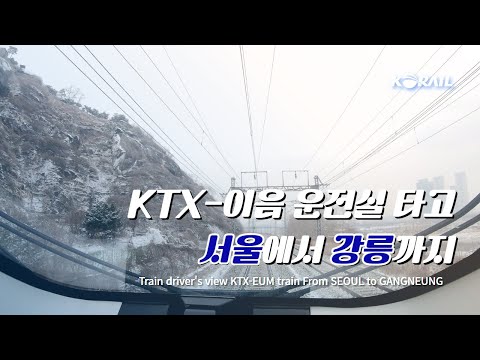
Watch for this in the Bergen Line film. East of Myrdal the trees disappear, the line runs through snow sheds around Hallingskeid, and then it enters the long Finse Tunnel and comes out beside the lake at Finse. Tunnels built for other reasons help in winter too. On the KTX Gangneung Line, about 63 per cent of the new section runs underground, so the snowy scenes in its winter film are the short open gaps between tunnels.
Points, wires and the small things that freeze
A blizzard is dramatic, but many winter delays start with something small. Points, the movable rails that switch a train from one track to another, need a clean gap to close. A lump of packed snow or ice between the blade and the fixed rail stops them locking, and the signal cannot clear. Network Rail fits electric heaters and insulation to points equipment for this reason, and its winter fleet carries hot-air blowers, steam jets, scrapers and anti-freeze. In snowy cab scenes, look at the points as the train passes over them: heated ones are often clear while the track around them is white.
Overhead wires bring their own risk, since ice on the contact wire or a third rail can stop a train drawing power. Before the Bergen Line was electrified, there were doubts about snow and ice on the catenary, until a test at Finse showed it could be kept clear. The Ofoten Line was electrified in 1923 and its ore trains run all winter, which was the point of building it to an ice-free harbour at Narvik. The Nordland Line has never been electrified, so its diesel trains carry their own power over Saltfjellet.
Watching the winter films on GONOM
Several GONOM films were made in snow. The Bernina Line film shows the pass deep in snow with Lago Bianco frozen beside the track, and snow clearance at Ospizio Bernina and Alp Grüm is part of that line's everyday work. The Bernese Oberland film to Grindelwald runs between snowy banks, the KTX Gangneung film was shot on a snowy day in the Taebaek range, and the TranzAlpine film was made in a New Zealand winter. On the Glacier Express route the panoramic train pauses for a few weeks between mid-October and early December, but ordinary trains run over the Albula line all winter.
For the northern lines, the route pages suggest when snow is at its best: February to April on the Bergen Line, winter on Dovrefjell for the Dovre Line, a snow-covered Saltfjellet on the Nordland Line, late winter and low Arctic light on the Ofoten Line, and in Scotland, winter snow over Drumochter on the Highland Main Line. Whichever you watch, look for fences on the windward side of open ground, sheds around exposed stations, ploughed banks in the cuttings and the care with which the driver approaches signals on slippery rails. Each is a sign of the work behind a timetable that looks ordinary.
Watch these journeys on GONOM
-
 Bergen Line
Bergen → Oslo
7h 14mBoard
-
 Ofoten Line and Iron Ore Line
Kiruna → Narvik
Full journeyBoard
-
 Dovre Line
Trondheim → Dombås
Full journeyBoard
-
 Nordland Line
Trondheim → Bodø
Full journeyBoard
-
 Tadami Line
Aizu-Wakamatsu → Koide
Full journeyBoard
-
 White Pass & Yukon Route
Skagway → Carcross
Full journeyBoard
-
 Bernina Line
St. Moritz → Tirano
1h 58mBoard
-
 Glacier Express route
St. Moritz → Chur
1h 54mBoard
-
 Bernese Oberland Railway
Interlaken Ost → Grindelwald
31mBoard
-
 KTX Gangneung Line
Seoul → Gangneung
2h 0mBoard
-
 TranzAlpine
Christchurch → Greymouth
Full journeyBoard
-
 Highland Main Line
Inverness → Pitlochry
Full journeyBoard
Sources
More guides
- How mountain railways climb: loops, spirals, switchbacks and rack
- How to watch a cab-ride video: signals, signs and what the driver sees
- Korea's east coast by rail: Gangwon, the Donghae Line and Busan
- Japan beyond the Shinkansen: slow local lines worth watching
- Why subway maps look the way they do
- Rail journeys of Norway and Sweden
- Crossing the Alps by train: the Alpine cab rides on GONOM and how they connect
- Planning a rail trip from a cab-ride video: how to go from watching a line to riding it
- Railways on the UNESCO World Heritage List, and what earned them a place
- Hill railways of South Asia: Darjeeling, the Nilgiris and Sri Lanka's tea country
- Narrow gauge explained: standard, broad, metre and 2 ft track, and why the width matters
- Coastal railways: why lines by the sea are so hard to build and keep open
- Railway tunnels: summit tunnels, base tunnels and how they are dug
- Rail through the seasons: when to ride which kind of line
- British rail journeys: the West Highland, Highland Main, Dartmoor and East Coast lines
- Metro, commuter rail, light rail or tram: how to tell city trains apart
- Korean trains explained: KTX, KTX-Eum, ITX, Nuriro and Mugunghwa
- Everyday regional trains of Central Europe, and why they are worth watching
- Scenic railways of the Americas and New Zealand: built for gold, silver and ports