How mountain railways climb: loops, spirals, switchbacks and rack
Why trains cannot simply go straight up a mountain, and how engineers used curves, spirals, zigzags, rack rails and viaducts to gain height, with GONOM rides for each.
The problem: steel wheels on steel rails
A train grips the track only through the small patch where each steel wheel meets a steel rail. That grip, called adhesion, is enough to move hundreds of tonnes on the level, but it fades quickly as the track tilts. Encyclopedic accounts put the practical ceiling for ordinary adhesion railways at around 10 per cent, and most main lines stay far below it, because heavy trains need margin for starting, braking and wet rails. So a railway that wants to cross a mountain has to find a way of spreading the climb over a much longer distance.
Gradients are written in two ways. A figure of 2 per cent means the track rises 2 m for every 100 m travelled; the British style writes the same slope as about 1 in 50. Keep those numbers in mind while you watch. The Semmering Railway holds its climb to 2 to 2.5 per cent over most of its length, the Albula line on the Glacier Express route to 3.5 per cent, the Flåm Line reaches 5.5 per cent and the Bernina Line 7 per cent, all without a rack.
Follow the contours and make the line longer
The oldest trick is simply to take the long way round. Instead of crossing a side valley on a high bridge, the track turns into it, runs up one side, curves around its head and comes back out along the other side. A curve that doubles back like this is called a horseshoe. It adds distance, and every extra metre of track lowers the gradient. The limit is the radius: curves that are too tight slow trains and wear the rails.
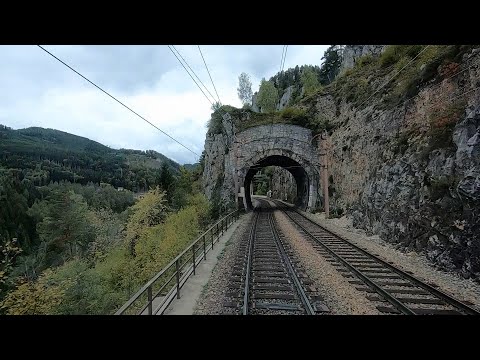
Carl von Ghega used this approach on the Semmering Railway in the 1850s, following the valley sides in curves as tight as 190 m in radius. In the Semmering cab ride, watch how often you can see your own line across a side valley, a ledge or viaduct you will reach a minute later. The White Pass & Yukon Route does the same on a granite shelf, gaining 879 m in about 32 km, and the Serra Verde Express in Brazil winds down the Serra do Mar on ledges, tunnels and the curved Carvalho viaduct.
Spirals: when the valley is too narrow to wander
In a narrow gorge there is no room for wide curves, so the track turns a full circle and crosses over itself, gaining height as it goes. That is the difference between a spiral and a horseshoe: a spiral passes above or below its own track. Many are hidden inside the rock as spiral tunnels. On the Albula section of the Glacier Express film, between Preda and Bergün, three spiral tunnels, two curved tunnels and four viaducts use 12 km of line to cover 6.5 km in a straight line. You go into a tunnel facing one way and come out heading the other.
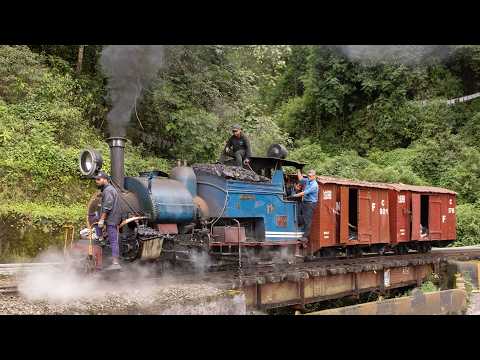
The Gotthard mountain line has spiral tunnels at the Biaschina and Piottino gorges in the Leventina, and loops around Wassen that show the village church three times, each at a different level. The Bernina Line builds its spiral in the open on the Brusio viaduct, where the track passes under its own arches. On the Darjeeling Himalayan Railway, the Batasia Loop below Ghum was added in 1919 to ease the gradient.
Switchbacks: forward, stop, reverse
A switchback, or zigzag, climbs a slope in straight legs. The train runs into a dead-end spur, the points are changed behind it, and it reverses up the next leg in a Z shape. Zigzags are cheaper to build than spirals and need fewer tunnels, but they cost time, and a train can be no longer than the shortest spur. That is why they survive mostly on small, steep lines, and why many have been bypassed.
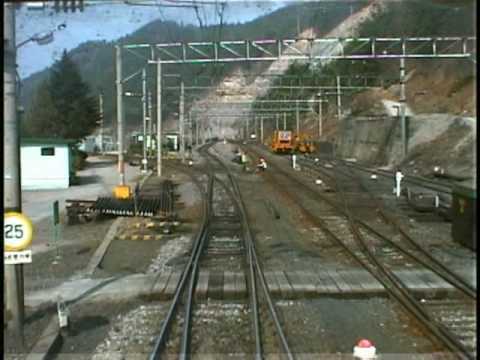
The Darjeeling Himalayan Railway still uses six zigzags and three loops; in 1882, loops and zigzags between Sukna and Gayabari evened its gradient out to 1 in 28. On the Alishan Forest Railway, the cab film reaches First Switch station at 1,827 m and then climbs through Z-shaped switchbacks that take the line above 2,000 m. The Yeongdong Line film, made in 2001, shows South Korea's only switchback between Heungjeon and Nahanjeong, where the track you came down and the track you are about to take lie one above the other. In 2012 it was replaced by the Solan Tunnel, a spiral more than 16 km long.
Rack and pinion: when adhesion is not enough
Beyond a certain steepness, the answer is a toothed rail laid between the running rails and a cog wheel, or pinion, under the train that meshes with it. Rack lines can climb far steeper slopes than any adhesion line and brake more securely. Some are rack all the way. Others, called rack-and-adhesion lines, run as ordinary railways and use the rack only on the steepest pitches. The best-known designs differ in the shape of the rack: Riggenbach's looks like a steel ladder, while Abt's uses two or three toothed bars with their teeth offset.
The Nilgiri Mountain Railway uses the Abt system between Kallar and Coonoor, where the gradient reaches 1 in 12, and it is the only rack railway still operating in India. The steam locomotive sits at the downhill end, so the film looks out from the leading coach as the train climbs at around 13 km/h. On the Bernese Oberland Railway to Grindelwald, look for the Riggenbach rack in the middle of the track on two short sections of up to 12 per cent.
Bridges, tunnels and the base-tunnel shortcut
Curves and spirals only work if the line can cross gorges and pass through spurs, so mountain railways are also lines of viaducts. On the Glacier Express route the Landwasser Viaduct stands 65 m high on a curve of only 100 m radius and runs straight into a tunnel in the cliff. On the Semmering, the Kalte Rinne viaduct is 46 m high; on the Nilgiri line the Adderly Viaduct crosses a gorge shortly after the water stop at Adderly.
The modern solution is to avoid most of the climb altogether with a long, low base tunnel. Since 2016 fast trains run about 500 m lower than the old Gotthard line, through a 57 km tunnel, and a base tunnel under the Semmering is expected around 2030. The old lines remain because they are worth riding slowly. When you watch any of them, look at station heights and gradient figures, and ask which trick the engineers are using at that moment.
Watch these journeys on GONOM
-
 Bernina Line
St. Moritz → Tirano
1h 58mBoard
-
 Glacier Express route
St. Moritz → Chur
1h 54mBoard
-
 Semmering Railway
Payerbach → Mürzzuschlag
Full journeyBoard
-
 White Pass & Yukon Route
Skagway → Carcross
Full journeyBoard
-
 Curitiba–Paranaguá Railway (Serra Verde Express)
Curitiba → Morretes
3h 12mBoard
-
 Gotthard mountain line
Bellinzona → Erstfeld
1h 28mBoard
-
 Darjeeling Himalayan Railway
Kurseong → Darjeeling
Full journeyBoard
-
 Yeongdong Line
Heungjeon → Dogye
10mBoard
-
 Alishan Forest Railway
Fenqihu → Alishan
Full journeyBoard
-
 Nilgiri Mountain Railway
Tunnel No. 3 (above Kallar) → Runneymede
48mBoard
-
 Bernese Oberland Railway
Interlaken Ost → Grindelwald
31mBoard
-
 Flåm Line
Myrdal → Flåm
Full journeyBoard
Sources
More guides
- How to watch a cab-ride video: signals, signs and what the driver sees
- Korea's east coast by rail: Gangwon, the Donghae Line and Busan
- Japan beyond the Shinkansen: slow local lines worth watching
- Why subway maps look the way they do
- Rail journeys of Norway and Sweden
- Crossing the Alps by train: the Alpine cab rides on GONOM and how they connect
- Planning a rail trip from a cab-ride video: how to go from watching a line to riding it
- Railways on the UNESCO World Heritage List, and what earned them a place
- Hill railways of South Asia: Darjeeling, the Nilgiris and Sri Lanka's tea country
- Narrow gauge explained: standard, broad, metre and 2 ft track, and why the width matters
- Coastal railways: why lines by the sea are so hard to build and keep open
- Railways in winter: how trains keep running through snow, ice and avalanches
- Railway tunnels: summit tunnels, base tunnels and how they are dug
- Rail through the seasons: when to ride which kind of line
- British rail journeys: the West Highland, Highland Main, Dartmoor and East Coast lines
- Metro, commuter rail, light rail or tram: how to tell city trains apart
- Korean trains explained: KTX, KTX-Eum, ITX, Nuriro and Mugunghwa
- Everyday regional trains of Central Europe, and why they are worth watching
- Scenic railways of the Americas and New Zealand: built for gold, silver and ports