Korean trains explained: KTX, KTX-Eum, ITX, Nuriro and Mugunghwa
A clear guide to Korea's train types, from KTX and KTX-Eum to ITX, Nuriro and Mugunghwa, how high-speed and conventional lines differ, and where subways fit in.
One network, two kinds of track
Korea's railways are easiest to understand as two layers. The first is a small set of dedicated high-speed lines, above all the Gyeongbu line from Seoul to Busan and the Honam line to the south-west. The second is the much larger conventional network, most of it built in the twentieth century, which reaches the coal towns, ports and farming counties. Most trains on both are run by Korail, which took that name when the old Korean National Railroad was split up on 1 January 2005. A second high-speed operator, SR, runs SRT trains from Suseo station in south-east Seoul.
The important point for travellers is that train names describe a class of service, not a line. A KTX can leave the high-speed line and continue on an upgraded conventional railway at lower speed, and a slow train can share a stretch of track with an express. Knowing the classes, from fastest to slowest, makes the timetable and the cab-ride videos much easier to read.
The KTX family
KTX, Korea Train eXpress, began regular service on 1 April 2004. The first trains were based on the French TGV Réseau and run at up to 305 km/h. Korea then built its own designs: the KTX-Sancheon, in service from 2 March 2010, and the KTX-Cheongryong, which joined the Gyeongbu and Honam services on 1 May 2024 with a top speed of 320 km/h. Away from the high-speed lines, KTX trains also run over upgraded conventional routes, for example on the Gyeongjeon Line towards Masan, the Jeolla Line to Yeosu and the Donghae Line into Pohang, where they are limited to 160 or 200 km/h.
The KTX-Eum, which entered service in January 2021 between Cheongnyangni and Andong, is different in design. Instead of power cars at each end it uses distributed traction, with motors spread along a six-car train, and it runs at up to 260 km/h. Every seat is aligned with a window. It now serves the Jungang, Gangneung, Jungbunaeryuk and Donghae lines, the routes where shorter, nimbler trains suit the demand.
Watching the difference on the KTX Gangneung Line
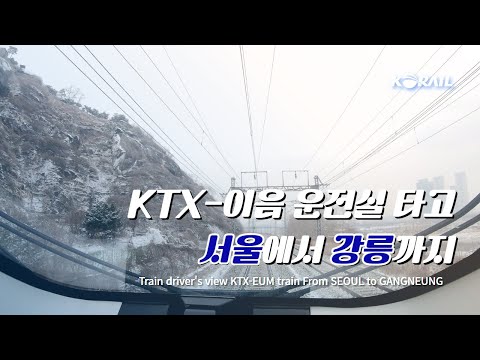
GONOM's KTX Gangneung video, filmed from the cab of a KTX-Eum, shows both layers of the network in one trip. For the first part the train is on existing railway through Seoul and then on the upgraded Jungang Line east along the Han valley, with junctions, older stations and suburban platforms. Only after Seowonju does it turn onto the new Gangneung Line, built for 250 km/h, where the character of the track changes: long straight alignments, few stations and about 63 percent of the route in tunnels.
That contrast is the clearest way to see what high-speed means in Korea. The new section avoids towns and valleys rather than following them, so the film becomes a sequence of tunnel mouths and brief views of snow and pine, ending with the almost 22 km Daegwallyeong Tunnel before Gangneung. The coastal journey that follows from Gangneung belongs to the slower classes, which is where the rest of this guide goes.
ITX: the express tier
Below the KTX sits ITX, Korail's family of intercity express trains. The first was the ITX-Cheongchun, introduced on the Gyeongchun Line in 2012. The ITX-Saemaeul took over the role of the old Saemaeul express, and the newest member, the ITX-Maum, entered service in 2023. It runs at 150 km/h, belongs to the same class as the ITX-Saemaeul and was introduced to replace the Mugunghwa, beginning on lines that include the Gyeongbu, Honam, Jeolla, Taebaek, Jungang, Donghae and Yeongdong.
The Gyeongchun Line video, filmed from an ITX-Cheongchun, shows how an express can share its line with commuter trains. Since 2010 the Gyeongchun Line has also been part of the Seoul Metropolitan Subway, so the stopping trains carry a subway line colour while the ITX runs through many of the same stations without stopping. Watch for the platforms the express passes, and for the stretch between Gapyeong and Namchuncheon that Korail itself picks out, with the Bukhangang running beside the track.
Mugunghwa and Nuriro: the trains that stop everywhere
The Mugunghwa, named after the national flower, has run under that name since 1984. It began as an express but became the regional train after the KTX arrived, and today it is Korail's slowest tier, calling at many towns and villages and taking roughly twice as long as a KTX over the same distance. Most Mugunghwa trains are locomotive-hauled, and the cars are built with room for standing passengers. On some rural lines it is the only passenger train there is, and it is due to be replaced by the ITX-Maum over time.
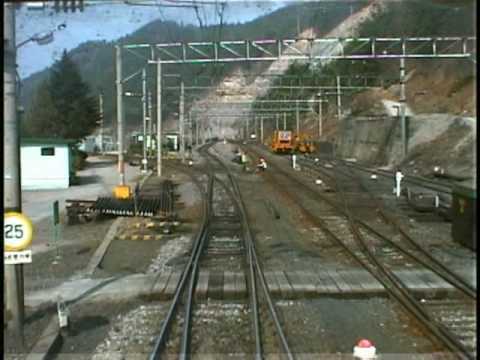
The Nuriro was introduced on 1 June 2009 to take over the short-distance Mugunghwa runs. It is an electric multiple unit with an operating speed of 150 km/h, used on the Jungang Line and on the Yeongdong Line. Both classes appear on GONOM. The Donghae Line video was filmed from a Nuriro running north from Pohang on single track, where trains wait for each other at passing stations, and the Yeongdong Line film was made in 2001 from a Mugunghwa on the old switchback above Dogye.
Commuter lines and the subway cities
The final layer is urban. Korail runs metropolitan commuter lines in the Seoul and Busan regions, with fares integrated with the subways, and some of them run through onto Seoul Lines 1, 3 and 4. GONOM's Seoul map shows Lines 1 to 9. At Seoul Station, Lines 1 and 4 meet the KTX and the airport railroad. The Daegu map shows Lines 1 to 3, with Line 1 directly under Dongdaegu, where both KTX and SRT trains stop.
Busan has Lines 1 to 4 and the Busan–Gimhae light rail on its GONOM map. Busan Station is the southern end of the Gyeongbu high-speed line, and the Donghae Line commuter trains meet the subway at Bujeon and several other stations. Haeundae Blue Line Park is something else again. It is a leisure ride on 4.8 km of the old coastal Donghae Nambu Line, with a Beach Train on the original track and the Sky Capsules seen in the GONOM video on an elevated rail above it. It is not part of the transport network, but it shows where the main line ran before it moved inland.
Watch these journeys on GONOM
-
 KTX Gangneung Line
Seoul → Gangneung
2h 0mBoard
-
 Gyeongchun Line
Yongsan → Chuncheon
Full journeyBoard
-
 Donghae Line
Pohang → Gangneung
Full journeyBoard
-
 Yeongdong Line
Heungjeon → Dogye
10mBoard
-
 Haeundae Blue Line Park
Cheongsapo → Mipo
32mBoard
Subway maps mentioned
Sources
More guides
- How mountain railways climb: loops, spirals, switchbacks and rack
- How to watch a cab-ride video: signals, signs and what the driver sees
- Korea's east coast by rail: Gangwon, the Donghae Line and Busan
- Japan beyond the Shinkansen: slow local lines worth watching
- Why subway maps look the way they do
- Rail journeys of Norway and Sweden
- Crossing the Alps by train: the Alpine cab rides on GONOM and how they connect
- Planning a rail trip from a cab-ride video: how to go from watching a line to riding it
- Railways on the UNESCO World Heritage List, and what earned them a place
- Hill railways of South Asia: Darjeeling, the Nilgiris and Sri Lanka's tea country
- Narrow gauge explained: standard, broad, metre and 2 ft track, and why the width matters
- Coastal railways: why lines by the sea are so hard to build and keep open
- Railways in winter: how trains keep running through snow, ice and avalanches
- Railway tunnels: summit tunnels, base tunnels and how they are dug
- Rail through the seasons: when to ride which kind of line
- British rail journeys: the West Highland, Highland Main, Dartmoor and East Coast lines
- Metro, commuter rail, light rail or tram: how to tell city trains apart
- Everyday regional trains of Central Europe, and why they are worth watching
- Scenic railways of the Americas and New Zealand: built for gold, silver and ports