Korea's east coast by rail: Gangwon, the Donghae Line and Busan
How Korea's east coast fits together by train, from the KTX to Gangneung and the new Donghae Line to Busan's seaside railway, and what each GONOM cab ride shows.
A coast the railway reached late
Gangwon Province is split in two by the Taebaek Mountains, the long ridge that runs down the eastern side of the Korean peninsula. West of the ridge lies the lake city of Chuncheon; east of it, a narrow strip of coast where Gangneung, Donghae and Samcheok face the East Sea. For most of the twentieth century the coastal side was hard to reach by train. Its railways were built to carry coal out of the mountains rather than people from Seoul, and the Mugunghwa from Seoul to Gangneung took close to six hours.
Two openings changed that. The KTX Gangneung Line arrived in December 2017, ahead of the Pyeongchang Winter Olympics, and on 1 January 2025 the last gap in the Donghae Line, between Yeongdeok and Samcheok, was closed, so that one railway now runs down the coast from Gangneung through Pohang to Busan. Gangneung has become the hinge of the network: the high-speed line from Seoul ends there, and the coastal trains to the south start there. The five GONOM rides in this guide all sit on that axis or close to it.
Seoul to Gangneung: the fast way across the mountains
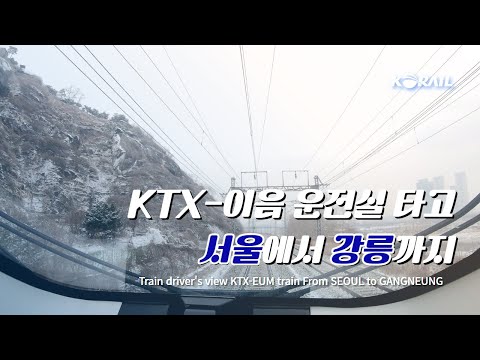
The KTX Gangneung Line is where most visitors begin. In the GONOM video, filmed from the cab of a KTX-Eum on a snowy winter day, the first stretch is all city: Seoul Station, the north bank of the Han, Cheongnyangni and Sangbong. After Seowonju the train turns onto the new line, and the ride changes character. About 63 percent of that section is in tunnels, so the film settles into a rhythm of darkness and short bright openings onto white fields and pine slopes around Hoengseong, Dunnae and Pyeongchang.
Watch for Jinbu, the station for Odaesan National Park, whose platforms were built long for the Olympic trains, and then the Daegwallyeong Tunnel, almost 22 km long and the longest dark passage in the video. When the train comes out, it is already on the coastal side of the range, running down into Gangneung. The sea cannot be seen from the line itself; the beaches are a short bus or taxi ride from the station. If you have only one day, this is the line that makes a return trip to the coast possible.
South along the sea on the Donghae Line
The Donghae Line video runs the other way, north from Pohang to Gangneung in the cab of a Nuriro regional train, and its first half is the newest railway in this guide. Beyond Yeongdeok the train calls at Hupo, Pyeonghae, Uljin and Jukbyeon, harbour and market towns that had no passenger trains before 2025, with forested hills on one side and glimpses of the sea on the other. North of Pohang the line is single track, so trains wait for each other at passing stations, and services are far less frequent than on the main lines out of Seoul.
From Donghae to Gangneung the train uses the coastal section of the Yeongdong Line, and this is the part of the film to watch closely. North of Mukho the track runs right beside the shore, and at Jeongdongjin the platform sits almost on the beach. The station looks east over open water, which has made it a favourite place to watch the sun come up. Since January 2025 ITX-Maum trains have run between Bujeon in Busan and Gangneung along this route, and at the end of 2025 Korail added KTX-Eum services, bringing the fastest journey under four hours.
The Yeongdong Line and the switchback that is gone
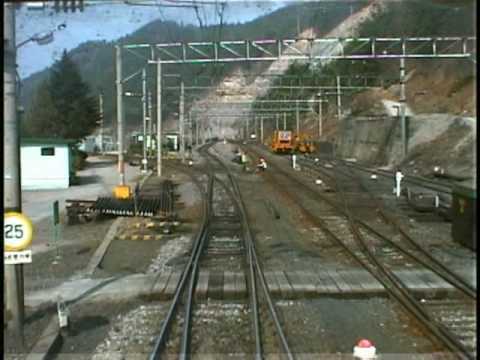
The Yeongdong Line is the old way to the coast, and its GONOM video is a record rather than a ride you can repeat. It was filmed in 2001 from a Mugunghwa train between Heungjeon and Dogye, on what was then the only switchback railway in South Korea. Here the line had to lose 435 m down a mountainside, so trains ran into a dead end, reversed and carried on downhill in a Z shape. In the film you can see how the track you have just come down and the track you are about to take lie one above the other on the same slope.
On 27 June 2012 the switchback closed, and trains began using the Solan Tunnel, more than 16 km long, which winds in a spiral under Yeonhwasan. Today's Mugunghwa trains pass that point in the dark, and the old section is used by the tourist trains of High1 Choo Choo Park. The rest of the line is still in service, from Yeongju through the mountains to Cheoram and Dogye, then along the coast past Donghae and Jeongdongjin to Gangneung. It is much slower than the KTX, but it passes through the coal towns the railway was first built to serve.
Chuncheon and Busan, the two ends
The Gyeongchun Line belongs to a separate day. It runs from Seoul to Chuncheon on the western side of the mountains, and no railway yet crosses from Chuncheon to the coast; a new line from Chuncheon to Sokcho has been under construction on all sections since 2025. The GONOM video follows an ITX-Cheongchun from Yongsan out of Seoul and up the valley of the Bukhangang. Korail picks out the stretch between Gapyeong and Namchuncheon, roughly 54 to 56 minutes into the film, as the highlight, when the river runs beside the track and mountains rise on the far bank.
At the southern end of the coast, Haeundae Blue Line Park in Busan reuses 4.8 km of the old Donghae Nambu Line, which main-line trains left in 2013. The GONOM video is taken from a Sky Capsule on the elevated rail between Cheongsapo and Mipo, with the Beach Train running on the original track below and Haeundae Beach and its towers coming closer ahead. The capsule covers about two kilometres in half an hour, and the slow pace suits it: it is a quiet way to follow a railway that once ran along this shore.
Linking up in Busan, and when to go
Coastal trains from Gangneung end at Bujeon, a short walk from Bujeon station on Busan Metro Line 1. GONOM's Busan subway map shows Lines 1 to 4 and the Busan–Gimhae light rail. From Bujeon, Line 1 takes you one stop to Seomyeon, where you change to Line 2 for Haeundae station, within walking distance of the beach and of Mipo at its eastern end. The Donghae Line commuter trains, which are not drawn on the map, meet the subway at Bujeon, Gyodae, Geoje and BEXCO and continue to Songjeong, the other end of the Beach Train.
For seasons, let the videos guide you. The mountains on the KTX ride lie under deep snow, which is typical from December to February. Summer brings crowds to the beaches, and weekend trains to Gangneung can sell out, so book early if your dates are fixed. Autumn colour reaches the Taebaek ridges in October and November, the best time for the Yeongdong Line, while the Gyeongchun valley is at its freshest in April and May. On the Donghae Line, a clear winter day gives the sharpest views out over the East Sea.
Watch these journeys on GONOM
-
 KTX Gangneung Line
Seoul → Gangneung
2h 0mBoard
-
 Donghae Line
Pohang → Gangneung
Full journeyBoard
-
 Yeongdong Line
Heungjeon → Dogye
10mBoard
-
 Gyeongchun Line
Yongsan → Chuncheon
Full journeyBoard
-
 Haeundae Blue Line Park
Cheongsapo → Mipo
32mBoard
Subway maps mentioned
Sources
More guides
- How mountain railways climb: loops, spirals, switchbacks and rack
- How to watch a cab-ride video: signals, signs and what the driver sees
- Japan beyond the Shinkansen: slow local lines worth watching
- Why subway maps look the way they do
- Rail journeys of Norway and Sweden
- Crossing the Alps by train: the Alpine cab rides on GONOM and how they connect
- Planning a rail trip from a cab-ride video: how to go from watching a line to riding it
- Railways on the UNESCO World Heritage List, and what earned them a place
- Hill railways of South Asia: Darjeeling, the Nilgiris and Sri Lanka's tea country
- Narrow gauge explained: standard, broad, metre and 2 ft track, and why the width matters
- Coastal railways: why lines by the sea are so hard to build and keep open
- Railways in winter: how trains keep running through snow, ice and avalanches
- Railway tunnels: summit tunnels, base tunnels and how they are dug
- Rail through the seasons: when to ride which kind of line
- British rail journeys: the West Highland, Highland Main, Dartmoor and East Coast lines
- Metro, commuter rail, light rail or tram: how to tell city trains apart
- Korean trains explained: KTX, KTX-Eum, ITX, Nuriro and Mugunghwa
- Everyday regional trains of Central Europe, and why they are worth watching
- Scenic railways of the Americas and New Zealand: built for gold, silver and ports