Japan beyond the Shinkansen: slow local lines worth watching
Why Japan's rural railways reward a slow ride: the Tadami and Gonō lines on GONOM, how one-person trains and unstaffed stations work, and how to reach them from the city.
Why watch a slow train
The Shinkansen is how most visitors see Japan by rail, and it is superb at what it does. But a high-speed line is built to get past the landscape quickly: long tunnels, viaducts and sound barriers keep the country at a distance. Japan's local lines work the other way. They follow rivers and coastlines and call at village after village, and from the driver's cab you can see the difference. The track bends with the valley or the shore, the next station is only a few minutes away, and the view ahead changes slowly enough to take in.
GONOM has three Japanese cab rides, and together they make a useful set. Two are rural lines in Tōhoku and Niigata, the Tadami Line and the Gonō Line, each taking four to five hours over ground a Shinkansen would cover far faster. The third, Tokyo's Yamanote Line, is the opposite: a city loop with a train every few minutes. Watching all three shows the range of Japanese railways, and it also helps with planning, because a trip on a slow line usually begins with a fast train out of a big city.
The Tadami Line: a river, its bridges and deep snow
The Tadami Line runs 135.2 km from Aizu-Wakamatsu in Fukushima to Koide in Niigata, and only three trains a day in each direction cover the full length, taking over four hours. The GONOM video follows the whole route. After the flat rice fields of the Aizu Basin, the Tadami River appears below the line, and the train crosses it again and again on numbered bridges. Look for the First Tadami River Bridge, an arch high over the gorge and the most photographed spot on the line, and later the Third Tadami River Bridge, where mist often lies on the water.
The middle of the line has a history worth knowing as you watch. In July 2011 torrential rain washed away the Fifth, Sixth and Seventh Tadami River bridges, and buses replaced trains between Aizu-Kawaguchi and Tadami for eleven years. Fukushima Prefecture agreed to buy the track and land so that JR East could run trains again, and the whole line reopened on 1 October 2022. This is also one of the snowiest parts of Japan. In winter the road over the Rokujūrigoe pass on the prefectural border is closed, and the railway, which passes under the border in a 6,359 m tunnel, becomes a vital link.
The Gonō Line: the Sea of Japan at the window
The Gonō Line video is filmed on the Resort Shirakami, a rapid train with large windows that JR East runs from Akita to Aomori, about 247.6 km in all. The Gonō Line itself is single track and not electrified, squeezed along a coast with few flat places, and once the train turns onto it at Higashi-Noshiro the sea is on the left for long stretches. Watch for low cliffs, rocky inlets and small harbours just below the track, the stop at Jūniko for the Twelve Lakes in the Shirakami beech forest, and the wide rock shelf at Senjōjiki, where trains stop only at certain times of year.
Beyond Ajigasawa the line leaves the sea and crosses the Tsugaru Plain, where apple orchards close in and Mount Iwaki stands alone on a clear day. A line this close to the water is exposed to the weather, and JR East's Akita branch warns of suspensions and delays on the Gonō Line when strong winds are forecast, so a spare day helps in winter. The Resort Shirakami is the easy way to see the coast, but ordinary local trains also run, and on some stretches there are only a handful a day.
How one-person trains and unstaffed stations work
On many rural lines the driver is the only member of staff on the train, and many stations have no staff at all. In Japanese this is called wanman, from the English words "one man". JR East sets out the routine for its short trains of one or two cars. At an unstaffed station, board by the rearmost door of the front car and take a numbered ticket, called a seiriken, from the machine on board, or a boarding certificate from the machine on the platform. On a two-car train, the doors of the second car stay closed at unstaffed stations.
To get off at an unstaffed station, use the frontmost door of the front car, beside the driver, and put your numbered ticket and the fare into the fare box. At staffed stations any door can be used and you pay or hand in your ticket as usual, and Suica and other IC cards work only within the Suica area. The KiHa E120 railcars at the Aizu-Wakamatsu end of the Tadami Line carry fare machines for this kind of driver-only service. Once you know the routine, the short trains and quiet platforms in the videos make more sense.
Tickets and timing for slow travel
Local trains need no seat reservation, and the Japan Rail Pass and JR East passes are valid on the Tadami and Gonō lines. Those passes also cover the Resort Shirakami, but every seat on it is reserved, so book one before you go. For people who enjoy slow trains, JR also sells the Seishun 18 Ticket for the spring, summer and winter school holidays. It is valid on local and rapid trains but not on the Shinkansen or limited expresses, and since October 2024 it is used on consecutive days only and cannot be shared between several people.
With so few trains on the rural sections, the timetable decides the day. Plan stops at places such as Aizu-Kawaguchi, Tadami, Jūniko or Fukaura around the next departure rather than the other way round, since on the middle of the Tadami Line a missed train can mean a wait of several hours, and check JR East for current services before you set out, especially in winter, when snow and wind are part of life on these lines.
Starting from the city: the Yamanote Line and GONOM's subway maps
Most trips to these lines begin in Tokyo, and the Yamanote Line video is a good way to learn the city's rail geography first. The inner loop runs counter-clockwise from Tokyo Station through Ueno, Ikebukuro, Shinjuku and Shibuya, calling at all 30 stations in about an hour. Tokyo and Ueno are where the Tōhoku and Jōetsu Shinkansen leave for the north. For the Tadami Line, take the Tōhoku Shinkansen to Kōriyama and the Ban'etsu West Line to Aizu-Wakamatsu, or start from Koide on the Jōetsu Line. For the Gonō Line, the Akita Shinkansen runs to Akita.
GONOM's Tokyo subway map, covering Tokyo Metro and the Toei lines, shows how Tokyo and Ueno stations link with the rest of the city. The maps for Osaka, Nagoya and Fukuoka help on the city days of a longer trip, and each marks where the subway meets the Shinkansen: Shin-Osaka on the Midosuji Line, Nagoya on the Higashiyama and Sakura-dori lines, and Hakata on the Kuko and Nanakuma lines, two stops from Fukuoka Airport. For now all of GONOM's Japanese local-line rides are in the north-east, so from western Japan expect a long Shinkansen day before the slow part begins.
Watch these journeys on GONOM
-
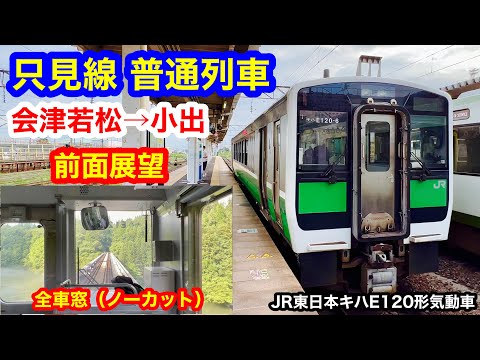 Tadami Line
Aizu-Wakamatsu → Koide
Full journeyBoard
-
 Gonō Line (Resort Shirakami)
Akita → Aomori
4h 59mBoard
-
 Yamanote Line (inner loop)
Tokyo → Tokyo
1h 7mBoard
Subway maps mentioned
Tokyo · Osaka · Nagoya · Fukuoka
Sources
More guides
- How mountain railways climb: loops, spirals, switchbacks and rack
- How to watch a cab-ride video: signals, signs and what the driver sees
- Korea's east coast by rail: Gangwon, the Donghae Line and Busan
- Why subway maps look the way they do
- Rail journeys of Norway and Sweden
- Crossing the Alps by train: the Alpine cab rides on GONOM and how they connect
- Planning a rail trip from a cab-ride video: how to go from watching a line to riding it
- Railways on the UNESCO World Heritage List, and what earned them a place
- Hill railways of South Asia: Darjeeling, the Nilgiris and Sri Lanka's tea country
- Narrow gauge explained: standard, broad, metre and 2 ft track, and why the width matters
- Coastal railways: why lines by the sea are so hard to build and keep open
- Railways in winter: how trains keep running through snow, ice and avalanches
- Railway tunnels: summit tunnels, base tunnels and how they are dug
- Rail through the seasons: when to ride which kind of line
- British rail journeys: the West Highland, Highland Main, Dartmoor and East Coast lines
- Metro, commuter rail, light rail or tram: how to tell city trains apart
- Korean trains explained: KTX, KTX-Eum, ITX, Nuriro and Mugunghwa
- Everyday regional trains of Central Europe, and why they are worth watching
- Scenic railways of the Americas and New Zealand: built for gold, silver and ports