Narrow gauge explained: standard, broad, metre and 2 ft track, and why the width matters
What track gauge is, how 1,435 mm became standard, and why builders chose metre, 3 ft or 2 ft gauge for mountains and remote places, with GONOM rides on each width.
What gauge measures
Track gauge is the distance between the inside edges of the two rails. It sounds like a detail, but it shapes almost everything else about a railway: how wide the trains can be, how tight the curves can be, how large the tunnels and bridges must be, and which other lines a train can run on. About 60 per cent of the world's railways use standard gauge, 1,435 mm or 4 ft 8½ in. Anything wider is broad gauge, anything narrower is narrow gauge, and most narrow gauges fall between 600 mm and 1,067 mm.
Gauge is not quite the same thing as the size of the train, and well-built 1,067 mm lines can come close to standard gauge performance. But in general a narrower track allows lighter rails, smaller structures and sharper curves, and that trade-off is what this guide is about. Among GONOM's cab-ride films you can see almost the full range, from 610 mm in the Himalaya to 1,676 mm in Sri Lanka.
How 1,435 mm became the standard
The odd figure comes from the coal wagonways of north-east England. George Stephenson worked on colliery lines in County Durham and used 4 ft 8 in on the Killingworth line and the Stockton and Darlington Railway. For the Liverpool and Manchester Railway of 1830 he added half an inch to give the wheels a little more play on curves. Because his lines spread first and furthest, his gauge spread with them.
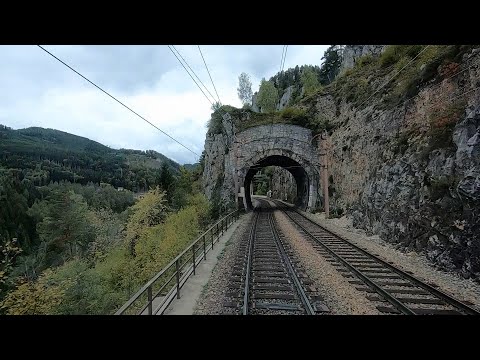
Not everyone agreed. Isambard Kingdom Brunel built the Great Western Railway to 7 ft ¼ in, and Britain went through years of argument known as the gauge war. The Gauge Act of 1846 required new passenger lines in Great Britain to use Stephenson's width, chiefly because far more track had already been built to it, and the Great Western finished converting in 1892. Most of Europe and North America use the same standard, as do South Korea's railways. The Semmering Railway and the Flåm Line are both standard gauge mountain lines.
Broad gauge, and the cost of meeting another gauge
Some countries went wider. India adopted 5 ft 6 in, or 1,676 mm, for its main lines, with economical freight and stability in mind, and Sri Lanka uses the same width; the Main Line film from Nanu Oya to Kandy runs on it all the way through the hill country. Spain and Portugal built their main networks to the Iberian gauge, and the Douro Line from Régua to Pocinho is laid to 1,668 mm.
Broad gauge has a cost wherever it meets narrower track. The Douro Line once had five metre-gauge branches running up into the hills, and until 1988 the narrow-gauge Sabor line brought iron ore down to Pocinho, where it had to be loaded into broad-gauge wagons. That transfer of every load from one train to another is called a break of gauge, and reducing it is the main reason networks later tried to use a single gauge. The Douro branches have all closed, the last in 2009.
Why narrow gauge suits mountains and remote places
In rough country, every extra centimetre of width costs money. A narrower track lets engineers lay lighter rails, cut smaller tunnels, build narrower ledges and bridges and, above all, use tighter curves, so the line can follow a slope instead of blasting through it. Where traffic is light, as in remote valleys or on industrial lines, these savings can decide whether a railway is built at all. The price is lower speeds on curves, smaller loads, and a break of gauge wherever the line meets the main network.
Metre gauge, 1,000 mm, is the classic compromise. The Rhaetian Railway uses it across Graubünden: in the Glacier Express film the Landwasser Viaduct swings across a gorge on a curve of only 100 m radius, and the Bernina Line drops more than 1,800 m without a rack. The Bernese Oberland Railway from Interlaken, the Nilgiri Mountain Railway and Spain's Ferrol–Gijón coast line, part of a metre-gauge network of about 650 km along the north coast, use it too. In India, metre gauge was introduced from 1872 as a cheaper way to extend the network.
Three feet and less
Below metre gauge come the truly small railways. The White Pass & Yukon Route was begun in 1898 on 3 ft gauge, and its builders pushed it up granite cliffs to the White Pass summit and on to Carcross in barely two years. Stockholm's Roslagsbanan keeps 891 mm, the old Swedish three-foot gauge, and is the last line of its kind in Sweden outside heritage railways. It is no museum piece: it is a busy commuter railway with double track as far as Vallentuna.
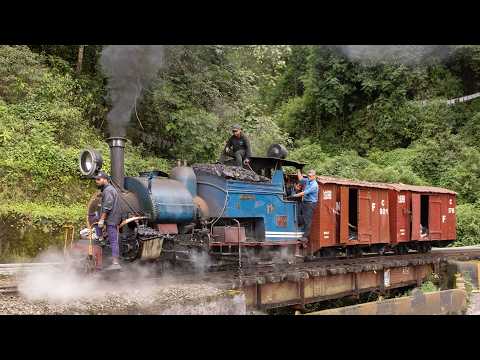
At 762 mm, or 2 ft 6 in, the Alishan Forest Railway in Taiwan was built to bring timber down from the mountains, with grades of up to 6.26 per cent and Z-shaped switchbacks; India's Kalka–Shimla Railway uses the same width. Narrowest of all on GONOM is the Darjeeling Himalayan Railway at 2 ft, or 610 mm. Its small B class engines climb along the Hill Cart Road and, for long stretches, run in the road itself, among cars and people on foot.
1,067 mm: a narrow gauge for whole countries
One narrow gauge became a national standard. At 1,067 mm, or 3 ft 6 in, it is the normal gauge in Japan, New Zealand, South Africa, Taiwan, Indonesia and parts of Australia. Japan's conventional lines, among them the Gonō Line along the Sea of Japan and the Tadami Line in Fukushima and Niigata, use it, while the Shinkansen was built separately to standard gauge. The TranzAlpine in New Zealand crosses the Southern Alps on the same 1,067 mm track. Taiwan's main lines use it too, which makes the 762 mm Alishan line a narrow gauge within a narrow-gauge country.
Conversions show that gauge is never quite permanent. In Norway the Trondheim–Støren section of the Dovre Line opened as narrow gauge in 1864 and was converted to standard gauge in 1921, when the mountain link to Dombås opened and through trains to Oslo became possible. India began Project Unigauge in 1990 to convert its main routes to broad gauge and cut out transfers between gauges, but the Nilgiri Mountain Railway is not expected to be converted.
Spotting the gauge in a cab ride
In the films, the easiest clue is the relation between the train and the track. On narrow gauge the rails look close together beneath a wide train, the sleepers look short, and curves come quickly, often on a ledge with a low wall or a drop on one side. Compare the Bernina Line with the Semmering Railway. Both are mountain lines, but the Bernina's metre-gauge track bends through village streets and along a lake shore, while the standard-gauge Semmering, built for heavy main-line trains, sweeps round in wider curves on tall viaducts.
On the Darjeeling film, watch the rails where they run beside the road kerb, and how little room the whole track takes up in the carriageway. The Main Line in Sri Lanka shows the opposite: broad-gauge track and full-size coaches winding through tea country, carried round the hills on long curves along the valley sides. Once you start noticing gauge, you will see it in every ride.
Watch these journeys on GONOM
-
 Semmering Railway
Payerbach → Mürzzuschlag
Full journeyBoard
-
 Flåm Line
Myrdal → Flåm
Full journeyBoard
-
 Main Line through the Hill Country
Nanu Oya → Kandy
Full journeyBoard
-
 Douro Line
Régua → Pocinho
Full journeyBoard
-
 Glacier Express route
St. Moritz → Chur
1h 54mBoard
-
 Bernina Line
St. Moritz → Tirano
1h 58mBoard
-
 Bernese Oberland Railway
Interlaken Ost → Grindelwald
31mBoard
-
 Nilgiri Mountain Railway
Tunnel No. 3 (above Kallar) → Runneymede
48mBoard
-
 Ferrol–Gijón Railway (Ribadeo – Viveiro)
Ribadeo → Viveiro
Full journeyBoard
-
 White Pass & Yukon Route
Skagway → Carcross
Full journeyBoard
-
 Roslagsbanan
Stockholm Östra → Kårsta
Full journeyBoard
-
 Alishan Forest Railway
Fenqihu → Alishan
Full journeyBoard
-
 Darjeeling Himalayan Railway
Kurseong → Darjeeling
Full journeyBoard
-
 Gonō Line (Resort Shirakami)
Akita → Aomori
4h 59mBoard
-
 Tadami Line
Aizu-Wakamatsu → Koide
Full journeyBoard
-
 TranzAlpine
Christchurch → Greymouth
Full journeyBoard
-
 Dovre Line
Trondheim → Dombås
Full journeyBoard
Subway maps mentioned
Sources
More guides
- How mountain railways climb: loops, spirals, switchbacks and rack
- How to watch a cab-ride video: signals, signs and what the driver sees
- Korea's east coast by rail: Gangwon, the Donghae Line and Busan
- Japan beyond the Shinkansen: slow local lines worth watching
- Why subway maps look the way they do
- Rail journeys of Norway and Sweden
- Crossing the Alps by train: the Alpine cab rides on GONOM and how they connect
- Planning a rail trip from a cab-ride video: how to go from watching a line to riding it
- Railways on the UNESCO World Heritage List, and what earned them a place
- Hill railways of South Asia: Darjeeling, the Nilgiris and Sri Lanka's tea country
- Coastal railways: why lines by the sea are so hard to build and keep open
- Railways in winter: how trains keep running through snow, ice and avalanches
- Railway tunnels: summit tunnels, base tunnels and how they are dug
- Rail through the seasons: when to ride which kind of line
- British rail journeys: the West Highland, Highland Main, Dartmoor and East Coast lines
- Metro, commuter rail, light rail or tram: how to tell city trains apart
- Korean trains explained: KTX, KTX-Eum, ITX, Nuriro and Mugunghwa
- Everyday regional trains of Central Europe, and why they are worth watching
- Scenic railways of the Americas and New Zealand: built for gold, silver and ports