Railway tunnels: summit tunnels, base tunnels and how they are dug
Why railways go underground and how tunnels are built, from hand-dug summit tunnels to the Gotthard Base Tunnel, and what to watch for in GONOM's cab films.
Why a railway goes into the mountain
A railway can only climb gently, so every mountain range forces a choice. The line can go over the top on long ramps, wind its way up in curves and spirals, or go through. A tunnel shortens the route and cuts out the steepest part of the climb, and in the far north it also takes the track out of the wind and snow. The cost is time and money. Tunnelling is slow and dangerous work, and every metre has to be paid for before a single train runs, which is why tunnels have grown longer as the methods have improved.
Engineers distinguish two kinds of crossing. A summit tunnel goes under the highest part of a pass, so the line still has to climb long ramps to reach it. A base tunnel goes through the mountain close to valley level, so trains barely climb at all. The Gotthard has both. Its summit tunnel of 1882, about 15 km long, reaches 1,151 m inside the mountain. The Gotthard Base Tunnel, opened in 2016, is 57 km long and peaks at about 549 m, roughly the height of Bern.
Summit tunnels: the Gotthard, Bohinj and Albula
The great tunnels of the late nineteenth and early twentieth centuries were summit tunnels. Louis Favre's Gotthard tunnel between Göschenen and Airolo cost the lives of around 200 workers, and Favre himself died inside it in 1879, months before the breakthrough. In GONOM's Gotthard mountain line film it is the long stretch after Airolo with nothing but the tunnel lights and the track ahead. When the train comes out at Göschenen, the station signs have changed from Italian to German.
The Bohinj Railway in Slovenia passes under Mount Kobla in a 6,327 m tunnel, still the longest railway tunnel in the country. After the First World War the new border between Yugoslavia and Italy ran through the middle of it. In the film the train spends several minutes in the dark after Bohinjska Bistrica and emerges at Podbrdo, at the head of a different valley. On the Glacier Express route, the 5,866 m Albula Tunnel takes the line under the pass at about 1,820 m; the spirals that follow below Preda are covered in GONOM's guide to how mountain railways climb.
Turning inside the rock: the Solan Tunnel and the Flåm Line
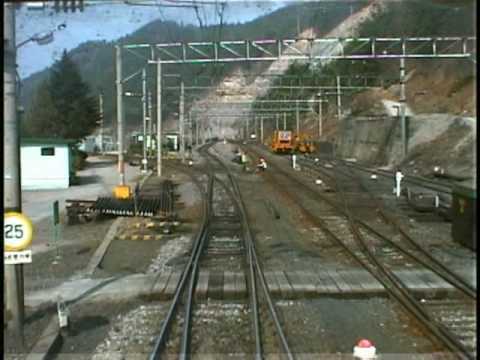
Sometimes a tunnel is used not to shorten a route but to lengthen it, so that the line can lose height inside the mountain. The most recent example on GONOM is in Korea. On the Yeongdong Line the drop from Tongni to Dogye was once handled by a switchback, which GONOM's 2001 film shows. In June 2012 it was replaced by the Solan Tunnel, more than 16 km long, which winds in a spiral beneath Yeonhwasan. Work had begun in 1999, and the new route cut the run between Dongbaeksan and Dogye from 36 to 16 minutes.
The Flåm Line does something similar on a smaller scale. It has twenty tunnels in 20.2 km, eighteen of them dug by hand, among them a turning tunnel that spirals in and out of the mountain. The longest is the Nåli Tunnel at 1,341 m. In the film, notice how the train enters the valley wall, curves in the dark and comes out high above the valley floor, looking at the river from a new angle.
Drill and blast, or a tunnel boring machine
There are two main ways to dig through hard rock. In drill and blast, crews drill a pattern of holes in the rock face, charge them with explosives and fire them, then clear away the broken rock and secure the new section before starting again. It is slow, but it adapts easily to short tunnels and changing ground. Many early tunnels were dug largely by hand: the Bergen Line's Gravhalsen Tunnel, 5,311 m long, was excavated manually through solid gneiss over six years.
A tunnel boring machine, or TBM, is a rotating cutting head with a long train of conveyors and support equipment behind it. It works continuously and is much faster on long drives through consistent rock, but it is costly and hard to adapt when the geology changes. Four Herrenknecht gripper TBMs bored about three quarters of the Gotthard Base Tunnel's two main tubes. Drill and blast was still used where it made sense, including about 11 km driven from the foot of the 800 m deep shafts at Sedrun. Across all 152 km of excavation, the split was roughly 56 per cent TBM and 44 per cent drill and blast.
Korea's Daegwallyeong Tunnel on the KTX Gangneung Line, 21.7 km long, was excavated by drill and blast between 2012 and 2015. In GONOM's film it is the almost 22 km of darkness after Jinbu. Because the line runs under the Daegwallyeong pass instead of over it, the KTX in the video reaches Gangneung about two hours after leaving Seoul Station; the old Mugunghwa train over the Yeongdong Line took close to six.
Air, heat and getting out safely
Long tunnels raise problems of air. In the steam era smoke filled them, and later diesel fumes did the same. The TranzAlpine's Otira Tunnel, 8.6 km long and completed in 1923, was once electrified; today a door closes behind each train so that it pushes the fumes out ahead of it like a piston. Deep tunnels are also hot. Without ventilation, the temperature inside the mountain around the Gotthard Base Tunnel reaches 46 °C, so cooling and fresh air are part of its design.
Modern safety thinking changed the shape of tunnels too. The Gotthard Base Tunnel is built as two single-track tubes rather than one double-track bore, joined about every 325 m by connecting galleries, so that passengers can always escape into the other tube. At Sedrun and Faido, multifunction stations serve as emergency stops and evacuation routes and house the ventilation equipment. Access tunnels reach the main tubes at Erstfeld, Amsteg, Sedrun, Faido and Giornico, which also gave the builders extra places to start digging.
Watching tunnels in a cab film
Tunnels are where most viewers skip ahead, but they repay attention. Watch the portal as it approaches: its shape, its stonework and whether it begins as a concrete gallery or bare rock. Inside, lights, signals and refuge niches pass at intervals, and the time spent in the dark gives a feel for the scale. In the Bergen Line film the 10.5 km Finse Tunnel holds the line's highest point. On the Tadami Line the 6,359 m Rokujūrigoe Tunnel carries the train from Fukushima into Niigata Prefecture.
Then look at what changes on the other side. Beyond the Otira Tunnel the TranzAlpine comes out into the wetter, greener country of the West Coast. Beyond the Gotthard summit tunnel the language changes. And on the Yeongdong Line, today's trains come out of the Solan Tunnel straight into Dogye, without the zigzag GONOM's older film records. A tunnel is a short pause in the view, but it is often the point where a journey passes from one region, climate or era to the next.
Watch these journeys on GONOM
-
 Gotthard mountain line
Bellinzona → Erstfeld
1h 28mBoard
-
 Bohinj Railway
Jesenice → Nova Gorica
Full journeyBoard
-
 Glacier Express route
St. Moritz → Chur
1h 54mBoard
-
 Yeongdong Line
Heungjeon → Dogye
10mBoard
-
 Flåm Line
Myrdal → Flåm
Full journeyBoard
-
 Bergen Line
Bergen → Oslo
7h 14mBoard
-
 KTX Gangneung Line
Seoul → Gangneung
2h 0mBoard
-
 TranzAlpine
Christchurch → Greymouth
Full journeyBoard
-
 Tadami Line
Aizu-Wakamatsu → Koide
Full journeyBoard
Sources
More guides
- How mountain railways climb: loops, spirals, switchbacks and rack
- How to watch a cab-ride video: signals, signs and what the driver sees
- Korea's east coast by rail: Gangwon, the Donghae Line and Busan
- Japan beyond the Shinkansen: slow local lines worth watching
- Why subway maps look the way they do
- Rail journeys of Norway and Sweden
- Crossing the Alps by train: the Alpine cab rides on GONOM and how they connect
- Planning a rail trip from a cab-ride video: how to go from watching a line to riding it
- Railways on the UNESCO World Heritage List, and what earned them a place
- Hill railways of South Asia: Darjeeling, the Nilgiris and Sri Lanka's tea country
- Narrow gauge explained: standard, broad, metre and 2 ft track, and why the width matters
- Coastal railways: why lines by the sea are so hard to build and keep open
- Railways in winter: how trains keep running through snow, ice and avalanches
- Rail through the seasons: when to ride which kind of line
- British rail journeys: the West Highland, Highland Main, Dartmoor and East Coast lines
- Metro, commuter rail, light rail or tram: how to tell city trains apart
- Korean trains explained: KTX, KTX-Eum, ITX, Nuriro and Mugunghwa
- Everyday regional trains of Central Europe, and why they are worth watching
- Scenic railways of the Americas and New Zealand: built for gold, silver and ports